
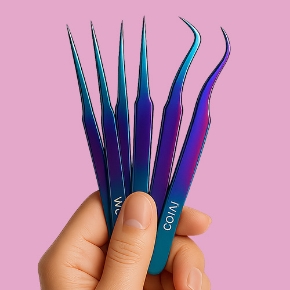


3D lash extensions (three ultra-fine extension fibres applied to a single natural lash) are the industry standard for light, wearable volume. While clients often confuse them with drugstore strip lashes, professional lash artists treat 3D volume as the sweet spot between classic definition and Russian volume density. Sourcing the right eyelash extension trays and matching diameters to natural lash health is essential for seamless retention.
In this technical masterclass from the WinLash Pro Educator Team, we break down exact fan weight ratios, curl combinations, handmade vs. premade fan economics, and proven adhesive techniques calibrated for lash studios operating across Dubai and the UAE.
Key Takeaways
- 3D lash extensions are fans of three fine extensions applied to one isolated natural lash.
- 0.07 mm is the most common diameter for 3D fans; 0.10 mm is usually too heavy for a three-fibre fan.
- "3D lashes" on strip or DIY packaging refers to layered, fluffy false lashes, not professional fans.
- 3D suits clients who want more fullness than classic, as long as their natural lashes are healthy enough to carry it.
Quick Access to This Article
- What Are 3D Lash Extensions?
- "3D Lashes" Can Mean Three Different Things
- 1D vs 2D vs 3D vs 4D Lashes
- Choosing Diameter, Curl and Length for 3D Fans
- How to Make 3D Fans by Hand
- 3D Premade Fans vs Handmade Fans
- Who 3D Lash Extensions Suit (and Who They Don't)
- Keeping 3D Sets Lasting in Hot, Humid Climates
- Safety and Natural Lash Health
- Common Mistakes with 3D Sets
- Frequently Asked Questions
- Conclusion
What Are 3D Lash Extensions?
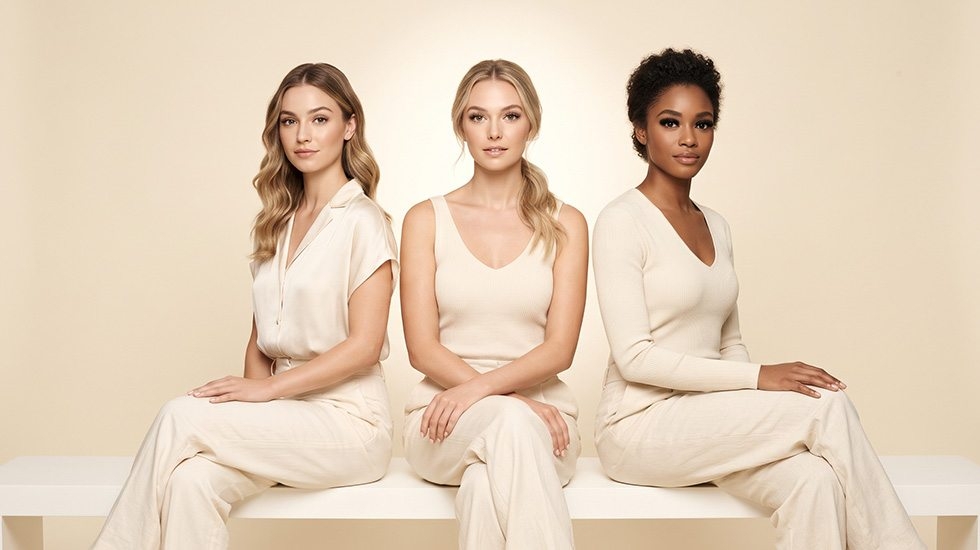
In professional lash extension work, the "D" stands for dimension, and the number tells you how many individual extensions make up each fan. A 3D fan is made of three ultra-fine extensions, gathered at the base and opened slightly at the tips, then attached as one unit to a single isolated natural lash.
Because three fibres point in slightly different directions, a 3D fan covers more space than one classic extension. The result is a softer, fuller and more textured lash line. 3D eyelash extensions sit in the "light volume" range: fuller than classic or 2D, but much softer than Russian or mega volume sets that use five, six or more fibres per fan.
What 3D lash extensions are not is three extensions glued across several natural lashes, or a single thick extension. Every fan still goes on one natural lash, and every fibre in it is much finer than a typical classic lash. This is what keeps 3D volume lashes light enough to wear comfortably.
"3D Lashes" Can Mean Three Different Things
One of the most common sources of confusion, for clients and newer artists alike, is that "3D" is also used by false lash brands to describe products that have nothing to do with fan size. When a client says they want "3D lashes," it's worth checking which of these they mean.
| Product | What "3D" means | Applied by | Wear time |
|---|---|---|---|
| 3D lash extensions | A fan of three fine extensions on one natural lash | A trained lash artist | Weeks, with fills every 2–3 weeks |
| 3D individual / DIY lash segments | Usually a marketing term for layered, fluffy clusters | The client, at home | A few days, depending on the bond |
| 3D strip lashes (often labelled "3D mink" or "faux mink") | Multi-layered strip lashes with a fluffy, crisscross look | The client, at home | One day, removed at night |
The overlap in naming means a client who has worn "3D mink" strips may expect a much denser, more dramatic look than a true 3D extension set. Showing reference photos of real 3D sets during the consultation avoids disappointment and helps you decide whether 3D, a larger fan size or a hybrid set is the better fit.
1D vs 2D vs 3D vs 4D Lashes
The numbers describe how many fibres are in each fan. As the number increases, each fibre needs to get finer so the total weight on the natural lash stays manageable.
| Fan size | Fibres per natural lash | Typical diameter | Look |
|---|---|---|---|
| 1D (classic) | 1 | About 0.10–0.15 mm | Defined, mascara-like |
| 2D | 2 | About 0.07 mm | Soft added fullness, very natural |
| 3D | 3 | About 0.05–0.07 mm | Fuller, fluffy and textured, still wearable |
| 4D | 4 | About 0.05–0.07 mm | Noticeably full and darker |
Many artists build sets using a mix of fan sizes, for example 2D in the inner corner and 3D–4D across the rest of the lash line. Searches for "2D 3D eyelash extensions" or "2D 3D 4D lashes" often come from clients trying to understand exactly this kind of graduated set.
Mapping a graduated 3D set
A simple, reliable approach is to divide the lash line into three zones. In the inner corner, where natural lashes are shortest and finest, use 2D fans or very small 3D fans with short lengths. Through the middle, switch to full 3D fans at your main lengths. Toward the outer corner, keep 3D fans and adjust length to suit the eye shape: slightly longer to elongate round eyes, or held steady for a balanced look on almond eyes. Because 3D extension lashes add density, small changes in fan size between zones are usually enough. Big jumps from 2D straight to 5D or 6D tend to look patchy rather than full.
Check the natural lashes zone by zone before you commit to a fan size. It's common for one area, often the outer corner or the inner third, to have weaker lashes than the rest. Dropping to a smaller or finer fan in that area protects the natural lashes without visibly changing the finished look.
Choosing Diameter, Curl and Length for 3D Fans
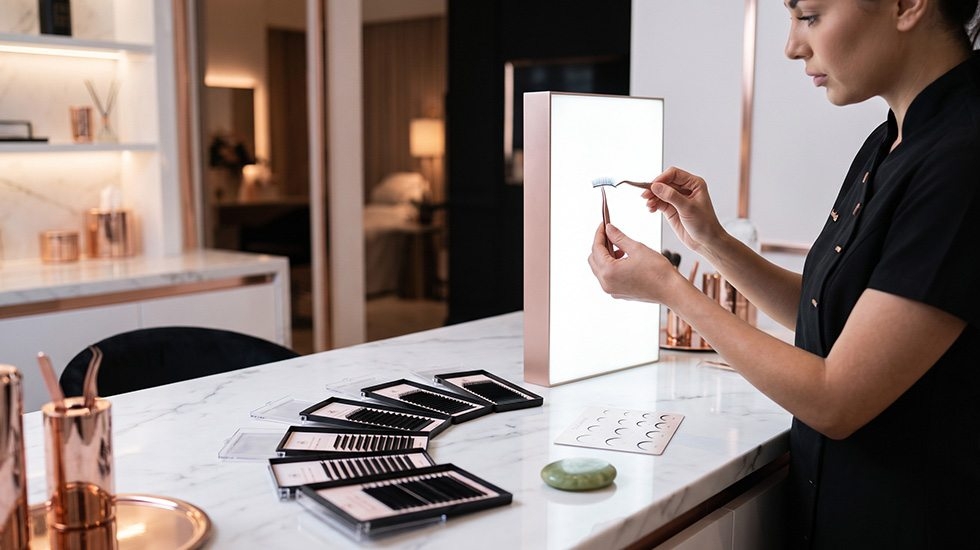
Diameter: why 0.07 mm is the standard
0.07 mm is the most widely used diameter for 3D volume lash extensions. It's fine enough to make a lightweight fan, but thick enough to give visible fullness and to be easy to handle while you're learning. Finer 0.05 mm fibres create a softer, fluffier 3D fan and are a good choice for clients with fine or weak natural lashes. A versatile 0.07 matte volume palette covers most 3D work in a single tray.
What about 0.10 3D lashes?
Some products and searches mention 0.10 mm 3D lashes or 0.10 premade fans. In most cases, 0.10 is too heavy for a three-fibre fan. Weight grows with the cross-section of each fibre, not just its thickness. Assuming the same length and material, a simple comparison shows why:
| Option | Approximate relative weight | Roughly comparable to |
|---|---|---|
| 3D fan in 0.05 mm | Very light | Lighter than a 0.10 mm classic lash |
| 3D fan in 0.07 mm | Light to moderate | A single 0.12 mm classic lash |
| 3D fan in 0.10 mm | Heavy | Heavier than a single 0.15 mm classic lash |
This is an approximation based on fibre cross-section rather than a measured product weight, but it shows the principle: a 0.10 mm 3D fan puts more load on the natural lash than most classic sets. Keep 0.10 for classic or 2D work on strong lashes, and use 0.05–0.07 for 3D.
Curl: C curl and beyond
C curl is the most common choice for 3D sets, and "3D C curl lashes" is a popular starting point for everyday light volume. It gives a natural lift that suits most almond and round eyes. CC and D curls create a more open, lifted look and work better for straight or downward-growing lashes and hooded eyes. Very strong curls on 3D fans can make the set look more dramatic than the client expects, so match the curl to the natural lash direction first.
Length
Keep lengths in proportion to the natural lash. Because a 3D fan adds density, overly long lengths can make the set look heavy even when the fibres are fine. Build length gradually from the inner corner outward, and use shorter lengths and smaller fans in the inner corner, where natural lashes are usually finer.
Quick Reference: Safe 3D Fan Specifications
| Natural Lash Type | Safe Diameter | Recommended Curl | WinLash Pro Choice |
|---|---|---|---|
| Fine / Weak / Damaged | 0.05 mm | B or C Curl | 0.05 Matte Silk Tray |
| Standard / Healthy | 0.07 mm | C, CC or D Curl | IB Black Velvet 0.07 |
| Downward-Growing | 0.05–0.07 mm | D or L Curl | Deep Lift D-Curl Palette |
How to Make 3D Fans by Hand
Making 3D fans by hand gives you full control over fan width and density. It's also the foundation for every larger volume style, so it's worth practicing until it feels automatic.
- Prepare your strip. Place a strip of lashes on your lash tile or palette, slightly angled so the bases are easy to reach.
- Pick up three fibres together. Using volume tweezers, grip three extensions near the base, a little way up from the very end.
- Open the fan. Gently roll or press the base so the tips spread into a soft fan. Aim for an even, symmetrical spread rather than a very wide one.
- Keep the base narrow. A tight, narrow base is what lets the fan wrap cleanly around one natural lash.
- Dip lightly. Dip only the base of the fan into a small amount of adhesive, so the fibres stay separated at the tips.
- Place on one isolated lash. Wrap the base around the isolated natural lash, slightly away from the skin, following its growth direction.
Easy fan lashes make this process faster, because the fibres separate into fans with very little effort when you pull them off the strip. A fast fan silk PBT palette is a practical choice for newer volume artists building speed, and for experienced artists on busy days.
3D Premade Fans vs Handmade Fans
3D premade fans, sometimes listed as 3D premade volume fans or 3D premade lashes, are factory-made fans with the base already bonded. They're picked up and applied directly, without fanning.
| Factor | Handmade 3D fans | 3D premade fans |
|---|---|---|
| Speed | Slower, especially while learning | Faster, no fanning needed |
| Consistency | Depends on the artist's skill | Very uniform |
| Customization | Full control over width and density | Fixed shape and width |
| Base | Thin and flexible when made well | Often a slightly thicker, pre-bonded base |
| Best for | Custom work and developing volume skills | Speed, uniform results and busy schedules |
Neither option is "cheating." Many professionals use handmade fans for custom work and premade fans when uniformity and time matter most. The key with premade fans is checking that the base isn't too thick or heavy for the natural lash, and that the diameter stays in the 0.05–0.07 mm range for 3D.
Who 3D Lash Extensions Suit (and Who They Don't)

3D lash extensions are a versatile middle ground, which makes them a great option for many clients, but not all of them.
Good candidates
- Clients who want more fullness than classic but still want a soft, wearable look
- Clients with gaps or slightly sparse areas in the natural lash line
- First-time volume clients who want to try volume without committing to a dramatic set
- Clients with healthy, medium-strength natural lashes
When to adjust or choose something else
- Very fine or weak natural lashes: use 2D or a 3D fan in 0.05 mm, with shorter lengths
- Clients who want a very dense, dark look: 4D–6D Russian volume may be a better match
- Clients who want a clean, defined look: classic may suit them better
- Clients with light or fine lashes who want a softer finish: brown fans reduce contrast; a dark brown volume palette works well for these 3D sets
Keeping 3D Sets Lasting in Hot, Humid Climates
In a climate like the UAE, heat and humidity affect both the application process and how the set performs afterward.
During application
In the UAE and Middle East, studio climates fluctuate dramatically between indoor air conditioning (typically 20°C–23°C with low humidity: 30%–45%) and extreme outdoor humidity. Standard lash adhesives cure via cyanoacrylate polymerization, which accelerates in high humidity and slows down in dry AC rooms. Keeping your studio conditions stable and using formulas calibrated for these fluctuations makes a decisive difference in set retention. You can source climate-matched options directly from our professional lash adhesives and liquids.
- Target Parameters: Maintain your studio between 21°C–23°C and 45%–55% relative humidity for optimal curing stability.
- Adhesive Selection: If your studio AC drops humidity below 40%, choose a flexible adhesive with a 0.5–1 second drying window to prevent shock-curing, crystallization, and brittle bonds.
- Drop Replacement: Refresh adhesive dots every 15–20 minutes (instead of the standard 30 minutes) to prevent premature glue skinning and oxidation on your jade stone or glue ring.
After the appointment
- Remind clients to keep their lashes dry for the time recommended by the adhesive's instructions
- Encourage regular, gentle cleansing, especially when they sweat often
- Advise against oil-based products near the eyes, since oil weakens the bond
- Recommend brushing fans gently so they stay separated and fluffy
Safety and Natural Lash Health
3D sets are generally gentle when the fans are matched to the natural lash, but the same standards apply as for any eyelash extension service.
Professional lash artists must follow strict hygiene standards aligned with UAE local salon health regulations and international lash safety protocols: always perform patch tests for sensitive clients, sanitize isolation tweezers in medical-grade barbicide, and never apply extensions to irritated or inflamed eyelids. Established international standards, such as these official eyelash extension safety tips, serve as a solid hygiene checklist for both artists and clients.
For natural lash health specifically, the two biggest risks with 3D work are fans that are too heavy for the natural lash and stickies, where a fan bonds two natural lashes together. Choosing the right diameter and isolating carefully prevents both.
Common Mistakes with 3D Sets
- Using 0.10 mm fibres for 3D fans: the fan becomes too heavy for most natural lashes
- Wide, open fan bases: they don't wrap cleanly around one natural lash and can create stickies
- Dipping too much adhesive: excess glue closes the fan and makes it look clumpy
- Overly wide fans: very wide 3D fans can look sparse and uneven rather than full
- Same fan size everywhere: inner corners usually need smaller, lighter fans
- Lengths too long for the natural lash: adds leverage and makes the set look heavy
- Not confirming expectations: a client who wants "3D mink" strip lashes may expect a much denser result
Frequently Asked Questions
What are 3D lash extensions?
3D lash extensions are fans made of three ultra-fine extensions, attached as one unit to a single natural lash, for a fuller and softer result than classic lashes.
What's the difference between 2D and 3D lashes?
2D fans use two fibres per natural lash for a subtle, natural boost in fullness. 3D fans use three fibres, giving more density and texture while still looking soft.
Are 3D volume lashes the same as 3D mink lashes?
No. 3D volume lashes are professional extension fans. "3D mink" usually refers to layered strip lashes that are applied at home and removed the same day.
What diameter is best for 3D lash extensions?
0.07 mm is the most common choice. 0.05 mm works well for fine or weak natural lashes. 0.10 mm is generally too heavy for a three-fibre fan.
Are 3D premade fans good for beginners?
They can help beginners work faster and get uniform results, but learning to make fans by hand is still important for custom work. Check that premade fan bases aren't too thick or heavy.
How long do 3D lash extensions last?
They shed with the natural lash cycle, so most clients book a fill every two to three weeks to keep the set full and even.
Conclusion
3D lash extensions are where many artists and clients first discover volume, and they reward getting the fundamentals right. A clean 3D set comes down to fine fibres in the 0.05–0.07 mm range, narrow fan bases, curls matched to the natural lash, lengths in proportion, and a clear conversation with the client about what "3D" really means. Master those details, and 3D becomes one of the most versatile, client-friendly styles in your menu.
Find volume lash trays, easy fan lashes, adhesives and studio supplies for your next 3D set at Winlash.