



Quick Access Table of Contents
Imagine spending your valuable time crafting a flawless, perfectly symmetrical mega volume fan, only to watch it instantly split, collapse, or slide out of your grasp the exact microsecond you lift it off the strip. For ambitious lash technicians, this isn’t just an irritating daily hurdle—it is a direct drain on your salon's speed, product inventory, and daily revenue. The truth is, your hand placement isn't the problem; the structural limitation lies entirely within traditional, smooth-jawed steel. A massive shift in tool technology is happening globally. By introducing micro-frictional metallurgy directly to your styling station, investing in high-performance tools from our premium tweezers and scissors collection permanently eradicates the nightmare of slipping fans, transforming how you control ultra-fine fibers.
Executive Brief: This technical guide strips away the marketing hype to analyze the physical science of fiber tip lash tweezers. You will learn how laser-etched hexagonal micro-mesh expands your tool's sweet spot to a definitive 100% full-coverage plane, why micro-friction drastically prevents hand fatigue during high-density sets, and how to calibrate your isolation and volume kit to unlock maximum operational speed.
The Material Science of Micro-Mesh Metallurgy
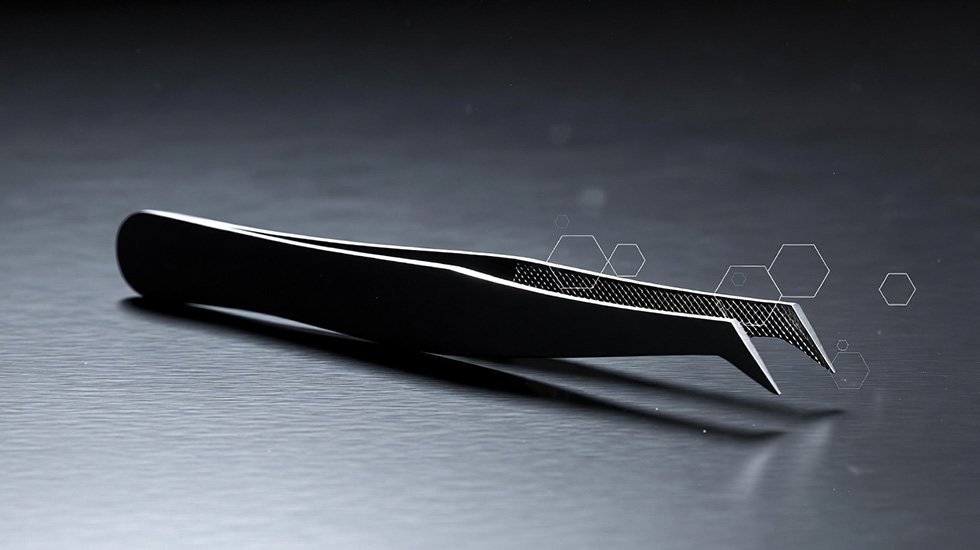
To truly appreciate why traditional tweezers fail during the construction of high-density mega volume fans, one must look closely at the interfacial physics between high-grade surgical stainless steel and advanced synthetic polymers. Standard premium volume tweezers are manufactured using high-tensile stainless steel alloys (typically martensitic grades like Japanese SUS440C or German 410/420 surgical steel). While these metals provide exceptional corrosion resistance and spring tension, their interior clamping jaws are ground down to a highly polished, mirror-smooth finish.
When a lash artist attempts to pick up or pinch a hand-crafted volume fan made of ultra-fine 0.03mm, 0.05mm, or 0.07mm premium Korean PBT eyelash extensions, they are dealing with a material known for its incredibly slick, low-surface-energy exterior. Polybutylene Terephthalate (PBT) is engineered to be smooth and non-porous to maintain its deep gloss and curl stability. Consequently, when smooth metal meets smooth PBT, the mechanical assembly relies 100% on raw, manual clamping pressure to compress the shifting bases of the extensions.
Because even the most perfectly aligned steel jaws contain microscopic structural air gaps, surface waves, and zero natural porosity at the nano-level, the slightest structural variance in finger pressure creates an immediate "slip window." The result is an instant salon disaster: the center lashes of the mega volume bundle slide backward out of alignment, the symmetry of the fan collapses into a messy clump, and valuable operational time, adhesive, and raw materials are permanently wasted.
Next-generation fiber tip tweezers overcome this deep structural limitation by altering the fundamental laws of contact mechanics. Rather than leaving the steel bare, manufacturers apply highly specialized surface-engineering technologies directly to the functional inside face of the tweezer tip:
- Advanced Chemical Vapor Deposition (CVD): A process conducted inside vacuum chambers where vaporized metalloid compounds are chemically reacted to fuse a micro-thin, high-hardness crystalline mesh layer permanently into the steel matrix.
- Precision Micro-Laser Texturing (Ultra-Short Pulse): Utilizing localized picosecond or femtosecond laser bursts to etch a hyper-precise, dense hexagonal or cross-hatched grid directly into the metal. The depth of these micro-grooves is calibrated precisely between 10 to 30 microns to perfectly mirror the curvature of ultra-fine extension bases.
- Crystalline Hybrid Coatings: Incorporating specialized diamond-like carbon (DLC) or titanium-fused matrices into the texturing to guarantee the micro-mesh valleys never dull down or flatten out, even after thousands of heavy-duty salon cycles.
How Micro-Friction Prevents Mega Volume Fan Collapse
Closing a premium fiber tip tweezer on a delicate bundle of synthetic extensions completely changes the mechanical dynamics of your workflow. Instead of applying simple lateral compression, the instrument instantly transitions into a series of active, physical interlocking structural anchors. By utilizing microscopic friction rather than aggressive hand force, this mechanical upgrade delivers definitive operational advantages:
- Multi-Point Mechanical Interlocking Topography
- The raised ridges of the micro-mesh bite gently into the cylindrical profiles of the PBT fibers without cutting or causing physical deformation to the extension.
- This action creates multi-directional locking anchors across every individual extension strand within the fan base, holding them entirely immobile.
- Symmetrical Stress and Force Distribution
- Traditional tweezers feature a localized 1mm to 2mm "sweet spot" where the steel fully meets. If your lash fan rests outside this exact millimeter, it instantly splits.
- The high-friction fiber texturing effectively equalizes the gripping force symmetrically across the entire inner mouth of the tool, converting the entire boot or curve into one massive, zero-defect sweet spot.
- Massive Increase in the Static Coefficient of Friction
- By introducing controlled structural roughness, the static coefficient of friction is elevated by over 300% compared to un-textured surgical steel.
- This extreme structural stability completely resists lateral kinetic slip, meaning heavy 15D, 20D, or complex mega volume fans can be lifted vertically off the sticky tape strip without a single lash shifting out of its radial placement.
To illustrate this in a live salon environment, look at the precise 4-step kinematic sequence that occurs during a perfect fan creation and lift when switching to a micro-mesh tool:
- The Pinch/Roll Phase: The artist spreads out and pinches the bases of the 0.03mm PBT extensions on the strip into a perfectly symmetrical, wide radial fan.
- The Low-Pressure Engagement: The fiber tip tweezer jaws close around the fan base. The micro-mesh instantly seats the extensions inside its valleys under minimal initial touch pressure.
- The Friction Lock: As the artist pulls back, the static friction threshold prevents any singular lash strand from shifting laterally or creeping backward. The fan's geometry is safely frozen in place.
- The Flawless Dip: The fan is cleanly extracted from the adhesive strip without collapsing, ready for a flawless dip into the cyanoacrylate adhesive and seamless attachment onto the natural lash.
The direct, real-world consequence of this metallurgical advancement is a massive reduction in occupational physical stress. Lash technicians no longer need to exert maximum, white-knuckle squeezing pressure to ensure their volume work doesn't fall apart. By letting the micro-textured tool handle the physical heavy lifting, artists can dramatically reduce chronic strain on the *thenar eminence* muscles, decrease hand fatigue, and actively shield themselves from career-shortening carpal tunnel syndrome during intensive, back-to-back mega volume appointments.
Technical Evaluation: Traditional vs. Fiber Tip Grid Jaws
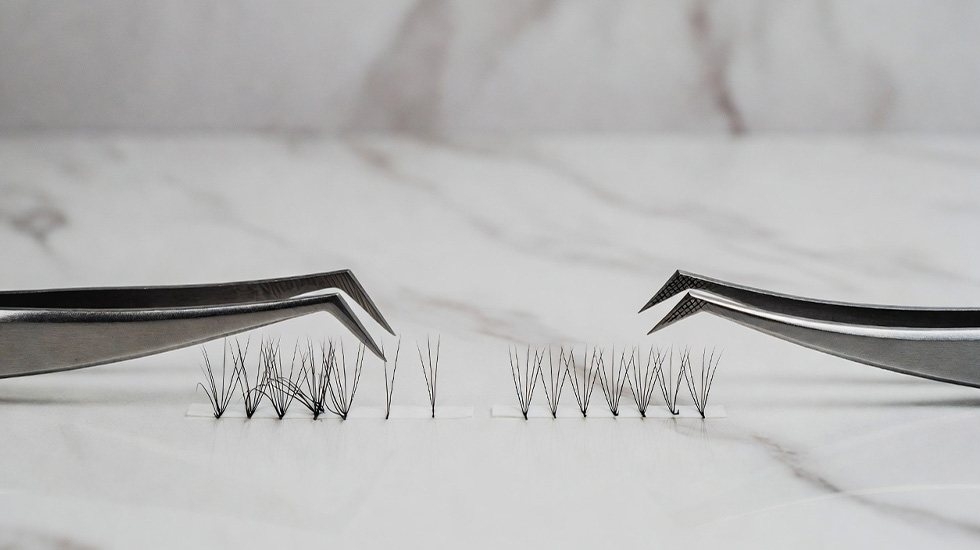
Selecting the perfect instrument requires analyzing the functional physics of the tool's jaws. Below is an engineering comparison detailing how micro-textured fiber tips transform everyday application metrics:
| Performance Parameter | Traditional Smooth Steel Jaws | Advanced Fiber Tip Grid Jaws |
|---|---|---|
| Sweet Spot Location | Highly localized (typically a 1-2mm zone near the center or front) | 100% Full-Coverage (From base to apex of the tip) |
| Required Hand Clamping Force | High (Requires consistent physical squeezing to hold fans) | Ultra-Low (Light touch engages the micro-textured grip) |
| Mega Volume Compatibility (0.03mm) | Unstable (Fibers regularly wrap, cross, or drop out) | Flawless (Locks up to 25D ultra-fine strands without shifting) |
| Adhesive Vapor Resistance | Moderate (Glue buildup glazes the tip, causing total grip failure) | High (Micro-grooves absorb minor outgassing without ruining grip) |
How to Configure Your Tweezer Kit: Isolation Meets Fiber Tip Volume
While fiber tip tweezers are the undisputed champion for creating and picking up volume fans, an elite lash set requires an integrated ecosystem of precision tools. A common mistake among salon professionals is focusing solely on the volume tweezer while ignoring the ergonomic dynamics of isolation.
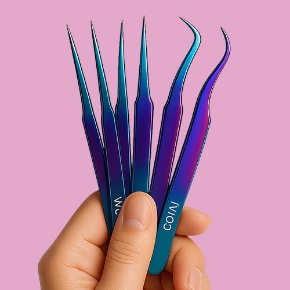
For seamless execution, serious technicians deploy a calibrated professional 2-piece lash tweezer set with a protective metal case. This ensures that while your dominant hand utilizes the unmatched holding power of fiber tips, your non-dominant hand isolates with surgical fluid motion. Depending on your personal hand anatomy and the client's facial bone structure, your isolation tool should be meticulously matched:
- The Deep-Set Eye Isolation: Utilize a specialized W2 curved tip lash tweezer to effortlessly navigate prominent brow bones without poking the client’s skin or losing your direct line of sight.
- The Ergonomic Corner Angle: Implement the iconic W9 dolphin curved tweezer, perfect for isolating the inner corners and delicate downward-facing natural lashes.
- The Classic High-Speed Vector: For high-speed master artists working on flat planes, a perfectly weighted W8 classic straight lash tweezer provides direct, linear muscle memory tracking.
Advanced Technical FAQ: Maintaining Fiber Tip Infrastructure
Because fiber tip tweezers feature a highly engineered micro-textured surface, they require distinct maintenance and cleaning protocols compared to traditional steel tools. Below, we address the critical questions submitted by working salon owners:
1. How do you clean cured cyanoacrylate lash glue out of fiber tips without ruining the mesh?
Never scrape the inner jaws of a fiber tip tweezer with sandpaper, files, or another sharp metal tool. Doing so will instantly shear off the microscopic laser-etched ridges, permanently ruining the high-friction grid system.
Instead, submerge the contaminated tips in a specialized liquid lash tweezer cleanser or pure acetone for a maximum of 2 to 3 minutes. The solvent will dissolve the polymer matrix of the cyanoacrylate glue within the nano-grooves. Once softened, gently wipe the tip clean using a lint-free microfiber wipe. Always dry thoroughly to prevent moisture crystallization.
2. Will chemical sterilization fluids or autoclaves degrade the fiber tip coating?
Premium fiber tip tweezers engineered from medical-grade surgical stainless steel can safely withstand standard sterilization routines, including hospital-grade disinfectants (Barbicide) and high-temperature steam autoclaves.
However, it is critical to adhere strictly to recommended immersion times. Leaving tweezers submerged in liquid chemical disinfectants for prolonged periods (e.g., overnight) can trigger chemical oxidation, leading to corrosion beneath the micro-mesh layer, causing it to flake off prematurely over time.
3. Why do mega volume fans still slide out even with a fiber tip tweezer?
If your volume fans are slipping through a fiber tip tool, it is almost always caused by one of two operational factors:
- Microscopic adhesive glazing: A thin, invisible film of dried adhesive has filled the valleys of the micro-mesh, rendering the surface completely flat and smooth again. Clean with acetone immediately.
- Incorrect alignment plane: Pulling or lifting the fan at an extreme angle that contradicts the direction of the micro-etched lines. Ensure you pull vertically or at a clean 90-degree vector to engage the maximum friction lock.
Investing in innovative tool technology is the fastest way to elevate your salon's reputation, slash your service times, and stop wasting high-cost materials. By combining advanced metallurgical engineering with premium design, WinLash continues to supply the Gulf region’s most demanding lash artists with the physical instruments required to master high-speed, zero-defect mega volume applications. Upgrade your station today and experience the absolute finality of slip-free fan creation.