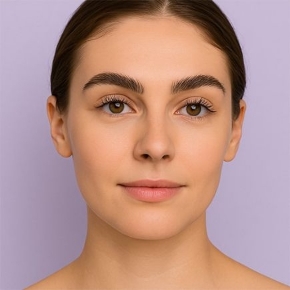

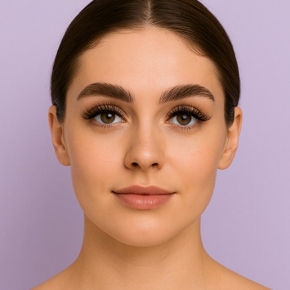
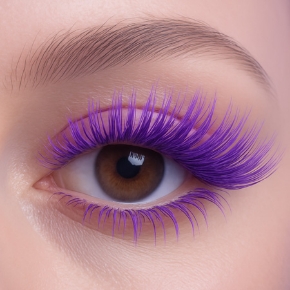
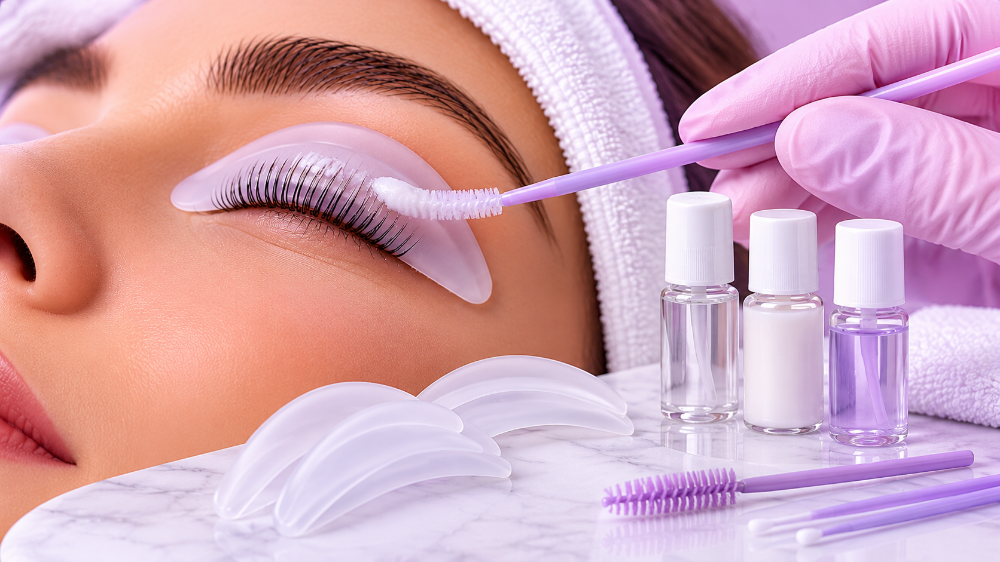
A keratin lash lift is a natural lash-lifting treatment that uses a conventional lifting and setting system alongside a keratin-containing product or conditioning step. The lifting lotions create the curl; keratin is generally included as part of the conditioning approach, depending on the product formulation. For lash artists comparing professional lash and brow lift products, understanding where keratin fits into the treatment is more useful than judging a system by its name alone.
But is a keratin lash lift actually different from a regular lash lift? And is it the same as a Korean lash lift? This guide explains what keratin adds, how the treatment works, what to expect from the results, and how professional lash artists can evaluate the formulas and individual steps in a lifting kit.
- A keratin lash lift uses the same basic lash-reshaping principle as a conventional lash lift.
- Keratin is generally associated with a conditioning or nourishing component; it is not the ingredient responsible for creating the curl.
- The main difference between keratin and regular lash lifts depends on the complete product formula and the treatment steps.
- A Korean lash lift may also use keratin-containing products, so the two terms are not necessarily mutually exclusive.
- Keratin does not automatically mean a tighter curl, longer-lasting results or damage-free treatment.
- Professional lash artists should check the ingredient list, manufacturer's protocol, processing instructions and compatibility of every product in the system.
Quick Access to This Article
- What Is a Keratin Lash Lift?
- What Does Keratin Actually Add?
- Keratin Lash Lift vs Regular Lash Lift
- Keratin Lash Lift vs Korean Lash Lift
- Is a Keratin Lash Lift Good for Natural Lashes?
- How Is a Keratin Lash Lift Performed?
- Keratin Lash Lift Before and After
- How Long Does a Keratin Lash Lift Last?
- How to Choose a Professional Keratin Lash Lift Kit
- Frequently Asked Questions
- Conclusion
What Is a Keratin Lash Lift?
.jpg "What Is a Keratin Lash Lift?")
The treatment follows the same fundamental principle as other lash lifts: the natural lashes are positioned on a silicone shield or another suitable support, reshaped with a lifting solution and stabilised with a setting solution. A keratin-containing product may then be used as part of the finishing or conditioning process, depending on the system.
One important distinction is that keratin lash lift is not a universally standardised chemical technique. Different brands may use the term for different formulations and treatment systems. Therefore, the product instructions and ingredient declaration matter more than the service name.
How the Treatment Lifts and Curls Natural Lashes
The lifting process changes the shape of the natural lash by altering the bonds within its keratin-based hair structure. A lifting lotion makes the lash more responsive to reshaping, while a second product helps stabilise the new shape.
The selected silicone shield, the direction in which the lashes are positioned and the technician's application technique all influence the finished curl. Keratin does not replace these lifting and setting stages.
Where Keratin Fits into the Treatment System
Keratin can appear in different parts of a cosmetic formulation, but professional lash lift systems frequently position keratin-containing products in their conditioning or finishing stage.
For example, one kit may describe its final step as a Hydrating Serum, while another specifically calls it a Keratin Nourishing Solution. These product names describe how manufacturers position their products, but they do not establish that all formulas contain the same ingredients or provide identical results.
For lash artists, the useful question is not simply whether a kit says "Keratin". It is whether the ingredient is actually listed, what other ingredients accompany it and which stage of the treatment uses the product.
What Does Keratin Actually Add to a Lash Lift?
Keratin is a structural protein naturally found in hair, including eyelashes. In cosmetic formulations, keratin-derived ingredients are commonly used for their conditioning properties. Their presence may contribute to the formulation's intended conditioning benefits, but it does not mean that a treatment can rebuild damaged lashes or reverse every effect of chemical processing.
Hydrolyzed keratin is a form of keratin that has been broken down into smaller protein fragments. It is used in cosmetic formulations, but the properties of commercially available hydrolyzed keratin materials can vary according to their characteristics and manufacturing processes.
A cosmetic ingredient safety assessment published by the Cosmetic Ingredient Review Expert Panel evaluated several keratin-derived ingredients and identified their principal functions as skin and hair conditioning agents. This provides a useful scientific reference for understanding how these ingredients are used in cosmetics; it is not clinical proof that every keratin lash lift produces stronger or healthier eyelashes.
Keratin Conditioning Ingredients vs. the Chemistry That Creates the Curl
These two functions should not be confused. The lifting and setting products determine the reshaping process, while a keratin-containing conditioning product is intended to provide a different function within the treatment.
| Treatment Component | Main Function | What It Contributes |
|---|---|---|
| Lifting lotion | Reshapes the natural lash structure | Makes the lash responsive to the selected curl or lift shape |
| Setting or neutralising lotion | Stabilises the reshaped lash | Helps maintain the selected shape |
| Keratin-containing serum | Conditioning or finishing, depending on the formula | Provides the conditioning properties intended by the formulation |
| Optional lash tint | Adds colour to natural lashes when an appropriate product is used | Creates a darker, more defined appearance |
The scientific ingredient assessment can be found in the Safety Assessment of Keratin and Keratin-Derived Ingredients as Used in Cosmetics.
Why the Complete Formula Matters More Than the Service Name
Two products can both be marketed as keratin lash lifts while containing different combinations of conditioning agents and different lifting and setting formulations.
Likewise, a regular lash lift kit may already include a nourishing serum containing keratin or other conditioning ingredients. This means that the distinction is not necessarily between a treatment that contains keratin and one that contains none.
To evaluate a professional system properly, check:
- The complete ingredient declaration for each treatment step.
- Whether keratin or hydrolyzed keratin is actually listed.
- Whether the product is a lifting lotion, setting lotion or conditioning treatment.
- Other conditioning ingredients included in the formula.
- The manufacturer's claims and supporting product documentation.
Keratin Lash Lift vs Regular Lash Lift: What's the Difference?
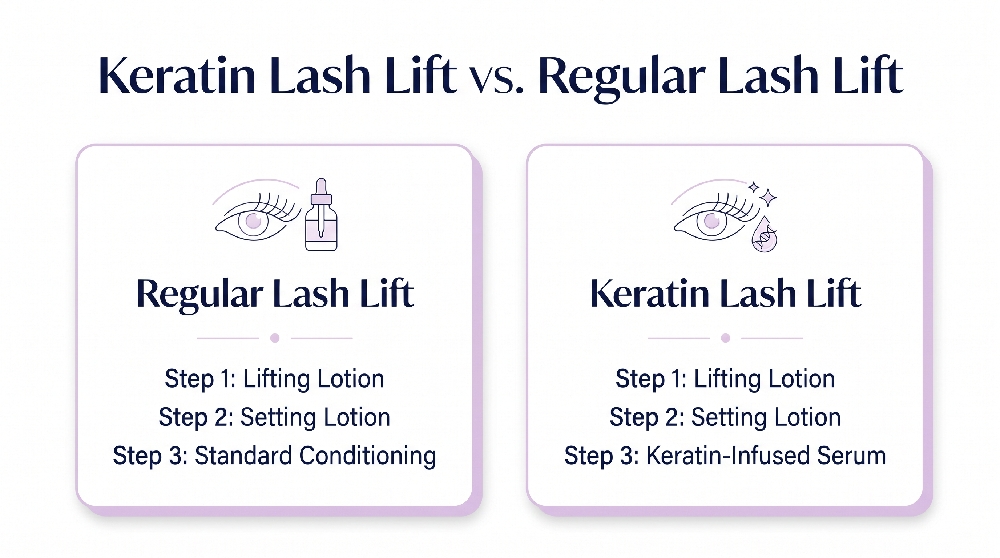
A keratin-labelled treatment highlights the inclusion or use of keratin in its formula or conditioning stage. A regular lash lift, however, may use another type of conditioning product or may also contain keratin. Therefore, the name alone does not establish a different lifting mechanism.
| Feature | Regular Lash Lift | Keratin Lash Lift |
|---|---|---|
| Main lifting process | Uses a chemical lifting system | Uses a chemical lifting system |
| Setting stage | Uses a setting or neutralising product | Uses a setting or neutralising product |
| Keratin component | Depends on the product formula | Highlighted as part of the system or conditioning approach |
| Conditioning stage | Depends on the brand | May include a keratin-containing finishing product |
| Curl result | Depends on shield selection and technique | Depends on shield selection and technique |
| Treatment longevity | Depends on the product and natural lash cycle | Depends on the product and natural lash cycle |
How the Lifting, Setting and Conditioning Stages Compare
The first two stages are responsible for reshaping and stabilising the lashes in both types of treatment. The conditioning stage is where product differences may become more noticeable.
For example, one manufacturer may supply a standard hydrating serum, while another may specifically formulate a keratin-containing serum. A third may include several conditioning ingredients together.
The correct comparison is therefore between the actual products and their ingredient lists, not simply between the words "regular" and "keratin".
Does Keratin Change the Curl, Processing Time or Lash Condition?
Keratin does not independently determine the curl shape. That result is primarily influenced by the lifting system, the support selected, the natural lash length and how the technician positions the lashes.
Processing times also depend on the complete formulation. A keratin-containing Step 3 does not automatically mean the lifting lotion should be left on for longer or shorter.
Similarly, the presence of keratin does not prove that the treatment is damage-free. The overall result and lash condition depend on correct product selection, appropriate processing, technique and the individual condition of the natural lashes.
Keratin Lash Lift vs Korean Lash Lift: Which Is Better?
Keratin and Korean lash lifts are not necessarily competing or mutually exclusive treatments. The terms describe different aspects of a lash-lifting service: keratin refers to an ingredient or product-positioning feature, while Korean lash lift is generally used to describe a technique, treatment style or branded system associated with Korean lash-lifting products.
A Korean lash lift can therefore use a keratin-containing product. The actual differences depend on the particular brand, formulation, application method and shield design.
Are Keratin and Korean Lash Lifts the Same?
No. They are not interchangeable descriptions, although a single treatment system may fit both labels.
A product may be marketed as Korean because of its technique or product system, while its Step 3 may contain keratin as a conditioning ingredient. In that case, the treatment can be described using both concepts without implying that they are two different chemical processes.
This is also why a brand's product instructions are more reliable than assumptions based on the treatment name.
How Their Formulas and Application Methods Can Differ
| Treatment Term | What It Describes | What to Check |
|---|---|---|
| Keratin Lash Lift | A keratin-associated treatment or product system | Ingredient declaration and the treatment stage where keratin is used |
| Korean Lash Lift | A technique, treatment style or branded system | Application method, lifting products, shield design and manufacturer's instructions |
| Regular Lash Lift | A general term for a natural lash-lifting service | The actual lifting and setting formulation, tools and conditioning products |
For a local service example, BROWZ describes its Korean Lash Lift as a keratin-based treatment. This illustrates how the terminology can overlap; it should not be treated as a universal formulation standard for every Korean lift.
What Should a Lash Artist Consider When Choosing Between Them?
Rather than choosing a treatment because its name sounds more advanced, evaluate the complete system:
- Check the lifting and setting ingredients.
- Compare the application instructions and intended treatment method.
- Look at the shape and size range of the compatible shields.
- Identify any conditioning products included in the kit.
- Choose the system according to your training, client assessment and the manufacturer's protocol.
There is no universal winner. The more appropriate choice is the system whose formulation, application requirements and intended results suit the treatment you are trained to perform.
Is a Keratin Lash Lift Good for Your Natural Lashes?
A keratin-containing lash lift may offer a conditioning component as part of the treatment, but its overall effect on natural lashes depends on the complete formula and how the service is performed.
It would be inaccurate to say that every keratin lash lift strengthens lashes, repairs all existing damage or prevents breakage. Keratin is a cosmetic ingredient, not a guarantee of a particular clinical outcome.
Potential Conditioning Benefits and Their Limits
Keratin-derived ingredients are used in cosmetics primarily for skin and hair conditioning. Depending on the formulation, a keratin-containing finishing product may be intended to improve the feel and cosmetic condition of treated hairs.
However, the effectiveness of one serum cannot be assumed from the name of its ingredient alone. Concentration, other components, product formulation and directions for use all matter. There is also a difference between making a lash feel conditioned and demonstrating that its underlying structure has been permanently repaired.
Possible Irritation, Overprocessing and Lash Breakage
The treatment still involves chemical products applied close to the eye. Incorrect processing, unsuitable formulations or unwanted product contact can irritate the eye area and may affect the lash fibre.
The peer-reviewed TFOS Lifestyle review on cosmetics and the ocular surface discusses eyelash perming, its chemical stages and potential short- and long-term ocular risks. It identifies irritation and contact dermatitis among the reported concerns associated with lifting and perming products.
Keratin in a finishing product does not cancel out these risks or make incorrect application safe.
Client Suitability, Patch Testing and When to Postpone Treatment
Before the treatment, examine the natural lashes and the skin around the eyes. Ask about previous reactions to lash adhesives, tints, lifting solutions and other eye-area cosmetics.
Follow the selected manufacturer's contraindications and allergy-test requirements. A patch test should be performed when required by the product instructions or applicable professional guidance, but a negative test does not guarantee that an allergic or irritant reaction cannot occur.
Postpone the treatment when the client has an active eye infection, inflamed eyelids, visibly compromised skin or another contraindication specified by the product manufacturer.
During application, maintain hygienic working conditions, use clean or single-use tools as appropriate, and prevent lifting lotions from contacting the eye. If significant irritation, pain or a visual disturbance occurs, stop the treatment and seek appropriate medical advice.
The FDA eye cosmetic safety guidance provides further advice on hygienic handling, ingredients and the risks of inappropriate products around the eyes. Its specific legal guidance on eyelash dyes relates to the United States; lash artists in the UAE must also follow applicable local requirements and their product instructions.
How Is a Keratin Lash Lift Performed?
A keratin lash lift generally follows the core stages of a professional lash lift. The exact sequence depends on the product system, particularly whether the keratin-containing product is integrated into the treatment or applied as a separate finishing step.
Client Consultation, Lash Assessment and Shield Selection
First, assess lash length, direction, density and condition. Discuss the client's preferred finish, whether they want a more rounded curl or a lifted appearance, and whether a tint is appropriate.
Select a shield that suits the natural lash length, eye shape and intended result. The lashes should be positioned evenly, with no unintended crossing or excessive tension. The chosen support influences the final appearance more directly than the presence of keratin in the kit.
The Lifting and Setting Stages
Use the lifting and setting products in the precise order provided by the manufacturer. Product compatibility, placement and processing limits must be followed for the specific system being used.
There is no universal processing time for all keratin lash lift kits. Hair characteristics, formulation and product instructions differ, so timings from another brand should never be copied as a substitute for the selected kit's protocol.
Keratin Conditioning and Optional Lash Tint
After the setting stage, the technician follows the product instructions to remove the lifting products and complete the finishing process. A keratin-containing serum may be used at this point if it is included in the kit's instructions.
A lash tint can also be offered as a separate service when the products are suitable for professional use around the eyes and the treatment protocols allow it. Tint adds colour rather than curl, so it changes the visual definition of the lashes without replacing the lifting process.
Do not assume that every lifting kit is compatible with every tint. Check the manufacturers' directions and applicable safety requirements before combining services.
How to Reduce the Risk of Uneven Processing
- Separate and align natural lashes carefully before applying the lifting products.
- Select a shield appropriate for the lash length and intended result.
- Avoid crossing, twisting or unevenly attaching lashes to the support.
- Use the processing chart provided for the exact product system.
- Inspect the finished result before releasing the client.
- Never repeat a chemical step simply to correct an uneven result without assessing the lash condition and following professional guidance.
Keratin Lash Lift Before and After: What Results Can You Expect?
.jpg "Keratin Lash Lift Before and After Results")
The result is not the same for every client. Natural lash length, density, growth direction, shield shape and placement all contribute to the finished appearance. A keratin-containing finishing product does not guarantee a more dramatic curl than a regular lash lift.
How Shield Size and Natural Lash Direction Affect the Result
A correctly selected shield helps determine how the lashes sit during the treatment. A design that creates a strong lift at the base can give a different impression from a more rounded curl, even when the same lifting formulation is used.
Natural lash direction is equally important. Downward-growing lashes may need a different placement approach from naturally upward-curving lashes. Long lashes also require sufficient support surface to position them without forcing the tips into an unsuitable shape.
What a Lash Lift Can and Cannot Change
A lash lift changes the appearance and direction of existing lashes. It does not create new lashes, permanently lengthen the fibres or add the volume associated with extensions.
For accurate before-and-after documentation, photograph both eyes in similar lighting, from a consistent angle and without mascara or other products that could change the appearance. Use authentic client results with permission rather than stock photographs presented as treatment evidence.
How Long Does a Keratin Lash Lift Last?
A keratin lash lift generally lasts around six to eight weeks, although the result varies between clients. This is a general lash-lifting estimate rather than a guaranteed keratin-specific advantage over a regular lash lift.
The treated part of each natural lash retains its shape until that lash is eventually shed and replaced. Because individual lashes are at different stages of the growth cycle, the overall result changes gradually as new lashes grow in with their natural direction.
The TFOS Lifestyle review of cosmetics and the ocular surface describes eyelash perming as a chemical procedure that changes lash curvature for approximately six to eight weeks. This supports using that range as a general reference rather than promising every client an identical duration.
Typical Longevity and the Natural Lash Growth Cycle
Natural lash shedding is one reason the lift gradually loses its uniform appearance. Some treated lashes remain curled while others shed and are replaced by new growth.
This means that there is no single day when every lash suddenly returns to its original position. Clients may notice a gradual change as the lash line renews.
Aftercare That Helps Maintain the Results
Aftercare should always follow the instructions for the treatment system used. Some manufacturers specify an initial period during which clients should avoid water, steam, rubbing or certain cosmetic products.
In general, clients should:
- Avoid rubbing, pulling or repeatedly manipulating treated lashes.
- Follow the manufacturer's instructions about water and steam exposure.
- Use eye-area cleansers suitable for their lashes and the treatment protocol.
- Avoid trying to correct an uneven result with additional chemical products at home.
- Follow professional advice before scheduling another lifting treatment.
Do not promise that keratin will extend the result beyond the expected lash growth cycle. A conditioning ingredient and the longevity of a chemically reshaped lash are two different considerations.
How to Choose a Professional Keratin Lash Lift Kit
Choosing a professional keratin lash lift kit requires looking beyond its marketing name. Lash artists should understand what each step does, which ingredients are included and whether the system provides clear instructions for the intended treatment.
A three-step system may include lifting cream, setting or neutralising cream and a finishing serum. However, the names and formulations of these steps differ between manufacturers.
What to Check in the Ingredient List and Active Formulas
Start by reviewing the product's ingredient declaration, instructions and manufacturer information. Do not rely only on phrases such as Keratin, Nourishing, Repair or Professional Strength.
- Ingredient declaration: Check whether keratin or hydrolyzed keratin is listed and identify the other conditioning ingredients.
- Lifting formula: Understand which product performs the reshaping stage and what its directions specify.
- Setting formula: Check which product stabilises the new shape and whether it is designed for use with the lifting lotion.
- Finishing serum: Determine whether the third step is a hydrating, conditioning or keratin-containing product.
- Product documentation: Check expiry information, warnings, storage requirements and the complete protocol.
- Tool compatibility: Confirm which shields, adhesives, combs and applicators are appropriate for the system.
Understanding the Role of Each Step, Especially Step 3
Step 3 deserves particular attention because this is where some manufacturers introduce a separate conditioning or nourishing product. However, a third step does not automatically contain keratin, and a product described as hydrating is not necessarily identical to one described as keratin-based.
For example, WinLash's product range includes several professional three-step systems with different Step 3 descriptions.
The kit is listed with three treatment stages:
- Step 1: Lifting Cream
- Step 2: Neutralizing Cream
- Step 3: Hydrating Serum
The product description also lists silicone curlers, lash adhesive and additional accessories. Check the individual product information for the exact formulation and current kit contents.
The WinLash product listing identifies the following steps:
- Step 1: Eyebrow and Eyelash Lifting Cream
- Step 2: Eyebrow and Eyelash Fixing Cream
- Step 3: Keratin Nourishing Solution
This example makes the keratin-labelled finishing stage explicit. It should not be interpreted as proof that the kit produces stronger results than another three-step system.
These examples illustrate why comparing Step 3 descriptions and product documentation is more meaningful than assuming every keratin-labelled kit uses the same formula.
Without the full ingredient lists and supporting manufacturer documentation, it would not be accurate to compare the concentration, performance or conditioning effectiveness of the two systems.
How to Compare Professional Kits Against Their Instructions and Intended Use
Before choosing a kit for your salon, use this practical comparison checklist:
| Evaluation Point | What a Lash Artist Should Verify |
|---|---|
| Complete ingredients | Whether keratin is listed and what other ingredients are included |
| Treatment stages | The exact purpose of Step 1, Step 2 and Step 3 |
| Processing instructions | Product-specific application and processing limits |
| Compatibility | Whether the lotions, shields and accessories are designed to work together |
| Professional guidance | Training materials, contraindications and safety instructions |
| Kit contents and usage | Packaging, number of applications, expiry and storage requirements |
A professional kit should be evaluated as a complete system. Selecting products based only on the presence of keratin can overlook important differences in lifting chemistry, application instructions and compatibility.
Frequently Asked Questions About Keratin Lash Lifts
Is a keratin lash lift good for your lashes?
A keratin lash lift may include a conditioning product, but the presence of keratin does not guarantee stronger or damage-free lashes. The result depends on the complete formulation, correct processing and the condition of the natural lashes.
What is the difference between a keratin lash lift and a normal lash lift?
Both reshape natural lashes using lifting and setting products. A keratin-labelled system highlights keratin in its formula or conditioning stage, while a normal lash lift may use different conditioning ingredients or may also contain keratin. The product formulation is the deciding factor.
How long will a keratin lash lift last?
A typical lash lift lasts around six to eight weeks. Natural lash shedding gradually changes the overall appearance, and keratin does not guarantee a longer-lasting result than a regular lash lift.
Is a keratin or Korean lash lift better?
Neither is automatically better. Keratin describes an ingredient or product feature, whereas Korean usually describes a treatment style or system. A Korean lift may also use keratin-containing products. Compare the actual formulas and application methods before choosing.
Can you combine a keratin lash lift with a lash tint?
A lash tint may be offered alongside a lift when both products are specifically intended for professional eye-area use and their instructions allow the combination. Tint adds colour and definition, while the lifting products change the lash shape.
Does a keratin lash lift damage natural lashes?
Damage is possible if the treatment is unsuitable, overprocessed or incorrectly applied. Keratin in the formula does not eliminate the risks associated with chemical lifting products. Client assessment and the manufacturer's processing instructions remain essential.
Does every keratin lash lift kit contain keratin in Step 3?
No universal rule determines which step must contain keratin. Many systems position conditioning products at the end of the treatment, but the actual ingredient placement depends on the brand and formulation. Always check the ingredient declaration rather than relying on the step number.
Conclusion: Look Beyond the Name of a Keratin Lash Lift
A keratin lash lift is not automatically a different type of chemical lifting process. Its defining feature is the inclusion or promotion of keratin within a particular product formula or conditioning approach. The actual curl is still created through the lifting and setting stages, with shield selection and lash placement determining much of the finished appearance.
For professional lash artists, the most useful approach is to look beyond marketing terminology. Check the complete ingredient list, understand the purpose of each treatment step and compare products according to their manufacturer's instructions. This helps you distinguish a genuinely different formulation from a familiar lash lift system with a different product label.
Explore the professional lash and brow lift kits, treatment solutions and accessories available at WinLash to compare systems and find the products that fit your salon's treatment needs.
Shop WinLashProfessional education only. Always follow the current manufacturer's instructions, product warnings and training for the exact lash-lifting system used. This article does not replace product-specific directions, professional training or applicable local regulations.