

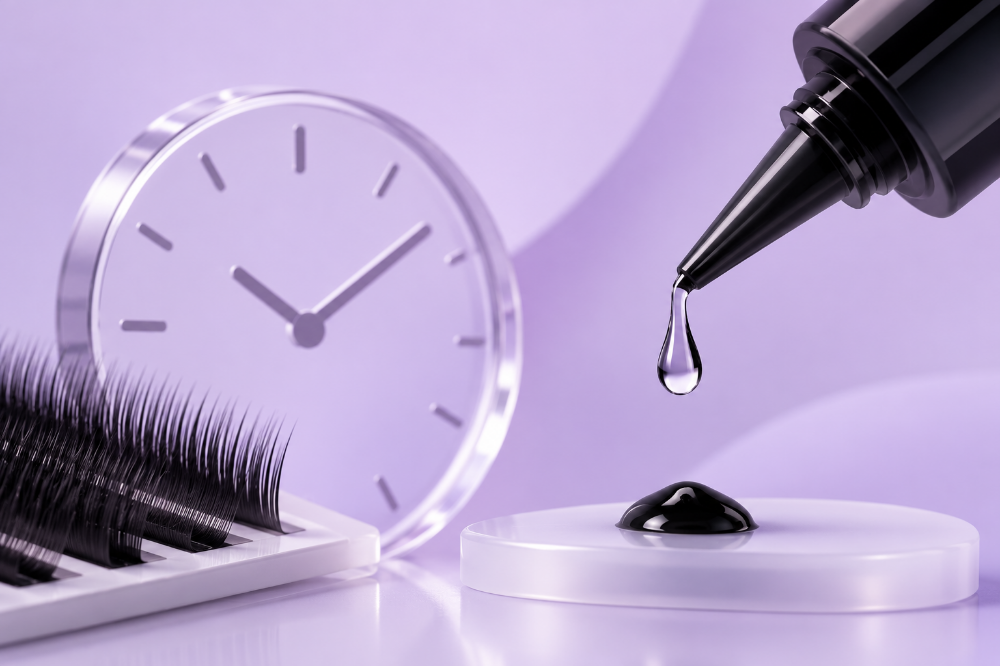
How long does lash glue take to dry? It depends on the adhesive. Strip lash glue commonly needs around 10–60 seconds to become tacky before application, while professional eyelash extension adhesives can have an initial setting time ranging from approximately 0.2 to 2 seconds or more. The advertised time is not the same as complete curing. For lash artists, humidity, temperature, adhesive formula and application technique all influence how the glue performs.
For professional lash artists comparing different formulas, WinLash offers a range of eyelash extension glues with different setting speeds and recommended working conditions. Comparing those specifications is a better starting point than choosing an adhesive simply because its advertised drying time is faster.
This guide compares 10 professional adhesives available through WinLash, explains the difference between initial setting and full curing, and shows how to troubleshoot lash glue that dries too quickly or too slowly in a Dubai lash room.
- Strip lash glue and professional extension adhesive have different application times. Do not use the same drying-time rule for both.
- WinLash professional extension adhesives in this comparison have listed setting times ranging from 0.2–0.3 seconds to 1–2 seconds.
- A glue's initial setting time does not mean its bonding process is completely finished.
- Humidity and temperature can change cyanoacrylate adhesive performance, so always check the working conditions specified for the individual product.
- The fastest adhesive is not automatically the best choice. Your application speed and working environment should determine which formula is suitable.
- When glue behaves differently, measure the room conditions and check the adhesive drop before changing products.
Quick Access to This Article
How Long Does Lash Glue Take to Dry?
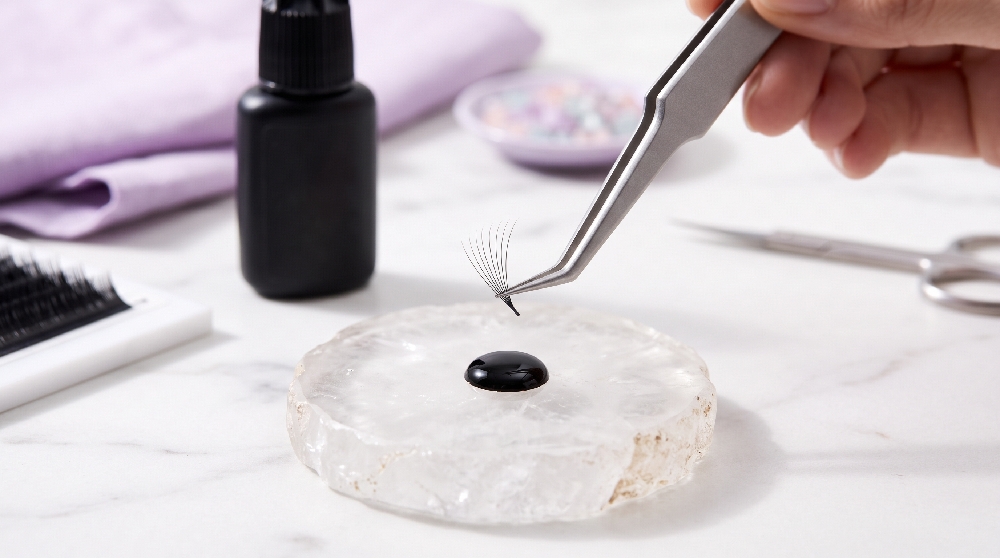
Lash glue does not have one universal drying time. The waiting period depends primarily on whether you are applying strip lashes, cluster lashes or individual eyelash extensions.
| Adhesive Type | Typical Application Timing | What to Wait For |
|---|---|---|
| Strip lash glue | Approximately 10–60 seconds | A tacky consistency before placing the lash band |
| Cluster lash bond | Formula-specific | The application-ready stage specified by the bond-and-seal system |
| Professional extension glue | Approximately 0.2–2 seconds for the WinLash examples below | The initial bond needed to secure the extension to the natural lash |
These timings describe different application processes. Strip lash glue usually needs to become tacky before the lash band is positioned. Professional extension glue, by contrast, is applied to an isolated natural lash and must set within the adhesive's working window.
How Long Does Strip Lash Glue Take to Become Tacky?
Many strip lash adhesives need approximately 10–60 seconds after application to become tacky enough for placement. However, the actual waiting time varies with the formula and the manufacturer's instructions.
Instead of relying only on a timer, check the adhesive's appearance and consistency. Some white strip lash glues become clearer as they dry, while others remain visibly coloured. The important point is to wait until the adhesive is sufficiently tacky to hold the lash band without excessive sliding.
How Long Does Professional Lash Extension Glue Take to Set?
Professional extension adhesives have much shorter advertised setting times. Some formulas are designed for highly experienced artists who can isolate and attach an extension in a fraction of a second, while other products provide a slightly longer placement window.
For example, WinLash lists DB Ultra at 0.2–0.3 seconds and DB MAX at 1–2 seconds. These figures refer to the products' stated initial setting times under their specified working conditions, not a guarantee that every application will perform identically.
The following comparison gives lash artists a practical reference when selecting a formula.
10 WinLash Lash Glues: Drying Time, Temperature and Humidity
One of the most useful ways to compare lash adhesives is to look at drying time alongside their recommended working conditions. Two products may have the same advertised setting speed but different temperature and humidity requirements.
| Lash Adhesive | Listed Drying Time | Working Temperature | Working Humidity |
|---|---|---|---|
| DB Ultra | 0.2–0.3 seconds | 18–28°C | 20–65% |
| WinLash Black | Under 0.5 seconds | 20–25°C | 40–70% |
| DB Super | 0.5 seconds | 15–27°C | 35–75% |
| BE Pulse | 0.5 seconds | 18–24°C | 40–70% |
| Sky Rose | 0.5 seconds | 23–28°C | 50–70% |
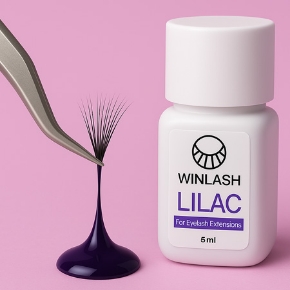
| WinLash Lilac | 0.5–1 second | 20–25°C | 40–70% |
| WinLash Pink | 0.5–1 second | 20–25°C | 40–70% |
| BE Perfect Speedy | 1 second | 18–24°C | 40–70% |
| WinLash Master Black | 1 second | 18–23°C | Not stated for working conditions* |
| DB MAX | 1–2 seconds | 18–27°C | 30–70% |
*WinLash Master Black lists a storage humidity of 45–60% RH, but this is not identified as a working humidity range. It should not be substituted for a recommended application range. The product listing specifies its working temperature separately.
The table shows why choosing an adhesive by drying time alone is not enough. DB Ultra has an exceptionally short advertised setting time, while DB MAX provides a longer application window. Their recommended environmental conditions also differ.
For a lash artist, the relevant question is not simply which glue is fastest. It is whether the adhesive can set consistently within the time available for accurate isolation and placement.
How Long Does Lash Cluster Glue Take to Dry?
Cluster lash adhesives should be treated separately from professional extension glues. Some cluster systems use a bond-and-seal approach, and their instructions may specify when to apply the clusters, when to use the seal and when the bond is ready for normal wear.
There is no reliable universal setting time for every cluster glue. Check the exact product instructions rather than applying the 0.5-second or 1-second timings of professional extension adhesives to a different formula.
Setting Time vs Full Curing: What Does Drying Time Really Mean?
.jpg "Lash Glue Initial Setting Time vs Full Curing Process")
One common misunderstanding in lash application is treating initial setting and complete curing as the same process. They describe different stages of adhesive performance.
What Does the Advertised Lash Glue Setting Time Mean?
The advertised setting time describes how quickly the adhesive forms an initial bond during application. For extension work, this is the working window in which the lash artist must correctly position the extension on the isolated natural lash.
For instance, a product advertised as a 0.5-second adhesive is designed to set very quickly under its specified conditions. It does not mean that the entire bonding process has finished in half a second.
What Is Full Curing Time?
Curing refers to the continued chemical process through which the adhesive develops its final bond properties. The initial set happens during application, but the adhesive can continue curing afterwards.
Many professional eyelash extension adhesives use cyanoacrylate chemistry. As general chemical background, Henkel's technical guide to cyanoacrylate adhesives explains that moisture and environmental conditions influence curing behaviour. This is a general adhesive reference, not a lash-specific curing schedule; the instructions for the actual lash adhesive must take priority.
For this reason, a professional should not interpret a bottle's advertised setting time as a guarantee of complete cure, final bond strength or immediate water resistance.
When Can Clients Shower or Get Their Lash Extensions Wet?
The appropriate aftercare period depends on the adhesive and the manufacturer's instructions. A quick initial setting time does not automatically mean the extensions can immediately be exposed to water, steam or other conditions restricted by the product's aftercare guidance.
Lash artists should give clients the instructions relevant to the adhesive actually used during the service. Avoid applying a universal 24-hour or 48-hour rule to every formula without checking its documentation.
What Affects Lash Glue Drying Time in a Dubai Lash Room?
.jpg "Monitoring Temperature and Humidity in a Dubai Lash Room")
Even when a product has a stated drying time, the working environment and application method can influence how it behaves. This is particularly important in Dubai, where an air-conditioned salon may have very different conditions from the outdoor environment.
How Humidity Affects Lash Adhesive Drying Time
Humidity is one of the important environmental variables for many cyanoacrylate-based lash adhesives. Moisture participates in the polymerisation process, so changes in relative humidity can alter how quickly an adhesive sets.
When humidity is higher than the range recommended for a particular formula, glue may set faster than the artist expects. When humidity is too low, some formulations may take longer to develop their initial bond.
However, this is not a reason to increase or reduce humidity blindly. A product designed for a particular humidity range should be used within that range. Different formulas can respond differently to the same room conditions.
How Temperature and Airflow Affect Lash Glue
Temperature can also influence adhesive behaviour. Many cyanoacrylate systems react faster in warmer conditions and more slowly in cooler conditions, although the exact response depends on the formulation.
Air conditioning adds another variable. It can change room temperature and humidity, while direct airflow towards the working area may make conditions less consistent. The temperature setting on an air conditioner does not tell you the actual humidity around the lash workstation.
For a more reliable working setup:
- Measure room temperature rather than estimating it.
- Use a digital hygrometer to check relative humidity.
- Keep the workstation within the adhesive's recommended environmental range.
- Avoid placing the client directly in a strong stream of air from an air conditioner or fan.
- Recheck conditions when the room environment changes during the day.
How Adhesive Formula, Viscosity and Glue Amount Affect Drying
Not every lash adhesive has the same formulation. Differences in viscosity, chemical composition and product design mean that two glues can perform differently even when their advertised setting times are similar.
The amount of adhesive used also matters. An excessively large drop or too much product on the extension can create an unsuitable application and affect bonding performance. Using a small, controlled amount according to the product instructions is preferable to trying to compensate for slow drying by adding more glue.
How Glue-Drop Freshness and Lash Preparation Affect Bonding
The adhesive drop changes as it remains exposed during a treatment. A drop that has been sitting on the glue holder may no longer behave like a fresh drop from the bottle.
Preparation also matters. Residue, oil, makeup or moisture on natural lashes can interfere with the intended bonding process. Follow the adhesive manufacturer's preparation instructions and use only compatible products.
For consistent results, keep the bottle closed between uses, maintain clean application tools and replace the working drop according to the product instructions and its observed condition.
How to Choose the Right Lash Glue Drying Time
Choosing the right adhesive involves more than comparing the smallest number of seconds. The glue should match the lash artist's working pace, experience, technique and actual room conditions.
Match Adhesive Speed to Your Application Pace
An ultra-fast adhesive may be suitable for an experienced artist who can isolate, pick up and position extensions accurately within a very short window. For an artist who needs more time to adjust placement, a slower formula may offer better control.
Consider the advertised setting time as a working specification rather than a competition. A suitable adhesive should allow correct placement and a reliable bond without forcing the technician to rush.
| Advertised Speed | What to Consider |
|---|---|
| Under 0.5 seconds | Requires very fast and precise placement; better suited to artists whose technique matches the short working window. |
| 0.5–1 second | A faster option for artists comfortable with relatively quick isolation and placement. |
| 1–2 seconds | Provides a longer initial placement window, depending on the formula and actual working conditions. |
These are general comparison categories, not a certification of suitability for a particular experience level. Always consider the specific adhesive's intended users and technical instructions.
Check the Manufacturer's Recommended Temperature and Humidity Range
Two adhesives with a 0.5-second advertised setting time may not have the same environmental requirements. For example, DB Super and Sky Rose have different recommended temperature and humidity ranges despite sharing the same stated setting time.
This is why an adhesive that performs well in one studio may not behave identically in another. Match the product to the environment rather than assuming that a particular drying speed works everywhere.
Use a Daily Adhesive Performance Log
One practical improvement is to record how your glue behaves alongside the environmental conditions. Rather than replacing an adhesive immediately whenever its performance changes, build a simple record of the working environment.
| What to Record | Why It Matters |
|---|---|
| Adhesive name and opening date | Helps track product age and storage history. |
| Room temperature | Shows whether the workstation is within the product's recommended range. |
| Relative humidity | Helps explain changes in adhesive setting behaviour. |
| Condition of the working glue drop | Helps identify when the drop needs replacement. |
| Observed application behaviour | Helps determine whether the adhesive is setting too early, too slowly or consistently. |
This gives the lash artist a more informed way to select products, identify environmental changes and maintain a consistent application routine.
Why Does Lash Glue Dry Too Fast or Too Slowly?
When an adhesive suddenly starts behaving differently, the first step should be to identify what has changed. It may be the room environment, the working drop, the product's condition or the suitability of its setting speed for the artist.
Why Does Lash Glue Set Too Quickly?
If glue starts setting before the extension can be positioned correctly, check the following:
- Humidity: Check whether relative humidity is above the adhesive's recommended working range.
- Temperature: Check whether the room has become warmer than the recommended working conditions.
- Adhesive speed: The product may be faster than the technician's current application pace.
- Working drop: Check whether the drop has changed consistency or should be replaced.
Do not immediately add moisture or change the room environment without understanding the product's recommended range. First identify the actual cause.
Why Is My Lash Glue Not Drying?
Slow setting can also be caused by several factors. Check the room humidity and temperature first. If either falls outside the recommended range, the adhesive may behave differently from its advertised speed.
Next, consider the working drop, product age, storage conditions, adhesive quantity and lash preparation. A contaminated or unsuitable working drop can create inconsistent results, while excessive adhesive may interfere with clean, controlled placement.
What If Glue Behaves Differently Throughout the Day?
A change during the day does not automatically mean the adhesive is defective. Room temperature and humidity may change when air conditioning cycles, doors open or the workstation moves between areas.
Use a hygrometer at the actual lash workstation and compare the readings with the glue's product specifications. If the environmental conditions are stable but the adhesive continues to behave abnormally, check its expiry, storage and current working instructions before using it again.
How Can You Make Lash Glue Dry Faster Safely?
If a professional adhesive is setting too slowly, the goal should be to restore the recommended working conditions rather than force the chemical reaction through uncontrolled heating or moisture.
Adjust the Room Conditions Within the Product's Recommended Range
Check temperature and relative humidity with a hygrometer. If the room is outside the adhesive's recommended range, make appropriate environmental adjustments and allow the workstation to stabilise before continuing.
Do not increase humidity or heat beyond the product's specified working conditions to chase a faster setting time.
Use a Fresh Glue Drop and the Correct Amount
Replace an aged working drop according to the manufacturer's instructions. Dispense a controlled amount of adhesive and pick up only what is required for the extension base.
Applying extra glue is not a reliable way to improve retention or compensate for slow setting. Correct isolation, suitable adhesive pickup and clean placement are more important.
Use an Accelerator or Bonder Only When the System Allows It
Some professional systems include a starter, bonder or accelerator designed to influence the bonding process. However, these products are not interchangeable, and their use depends on the manufacturer's compatibility and application instructions.
For example, the IB Starter Super Bonder is listed as a product that prepares the artificial lash surface and supports adhesive bonding. It should only be used according to its specified application method and in a compatible professional system.
Avoid using hairdryers, direct heat, uncontrolled misting or excessive moisture to force an adhesive to set. An artificially accelerated bond is not necessarily a correctly formed or more reliable bond.
Frequently Asked Questions About Lash Glue Drying Time
How long does lash glue take to dry completely?
The initial setting time and complete curing time are different. Professional extension adhesives may set within fractions of a second, but the bonding process can continue afterwards. Follow the exact curing and aftercare instructions for the adhesive used.
How long should lash glue dry before applying?
For many strip lash adhesives, allow approximately 10–60 seconds for the formula to become tacky before applying the lash band. Professional extension adhesives have a different working process and should not be left to dry before attachment. Follow the product instructions.
How can I dry eyelash glue quickly?
Use the adhesive within its recommended temperature and humidity range, apply the correct amount and replace an aged working drop when necessary. For professional extension adhesives, do not use direct heat or uncontrolled moisture to force faster curing.
Why is my lash extension glue not drying?
Possible causes include humidity or temperature outside the recommended range, an unsuitable adhesive drop, incorrect storage, excessive glue or insufficient lash preparation. Compare your room readings with the product specifications before changing the adhesive.
Does humidity make lash glue dry faster?
Humidity can affect the setting speed of many cyanoacrylate-based lash adhesives. Increased moisture may accelerate polymerisation, while low humidity can slow it. The exact response depends on the formula and its specified working range.
Can I shower immediately after getting lash extensions?
Do not use the advertised initial setting time as permission to shower immediately. Ask your lash artist and follow the specific adhesive manufacturer's instructions for water, steam and aftercare.
How long does lash cluster glue take to dry?
Cluster adhesive timing depends on the bond-and-seal formula. Follow the manufacturer's recommended waiting time and application sequence rather than using professional extension glue setting times.
Why does lash glue dry too quickly during application?
The room may be warmer or more humid than the recommended conditions, or the adhesive may be too fast for the artist's current placement pace. Check the environmental readings and consider an adhesive with a more suitable setting time.
Conclusion: The Right Lash Glue Drying Time Is More Than Just Seconds
How long lash glue takes to dry depends on the adhesive type, formulation and working environment. Strip lash glue needs time to become tacky, while professional extension adhesives may establish an initial bond in a fraction of a second. Neither timing should be confused with complete curing.
For lash artists in Dubai, the most reliable approach is to compare the adhesive's advertised setting time with its recommended temperature and humidity range. Monitoring room conditions, maintaining fresh glue drops and choosing a speed that matches your application technique can help make performance more consistent.
Rather than automatically choosing the fastest formula, look at the adhesive's actual specifications and the needs of your working technique.
Explore WinLash's professional lash adhesives and choose a formula that matches your application requirements.
Shop WinLash