
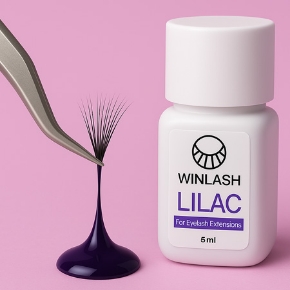
professional lash extension adhesives without cyanoacrylate do exist. They are not all made in the same way: some use alternative polymer-based bonding systems, while others are designed to cure under a compatible LED light. Their application, working conditions and performance can differ from conventional adhesives, and cyanoacrylate-free does not automatically mean hypoallergenic. Lash artists comparing products can start with WinLash's professional lash extension glue range, but should only describe a specific adhesive as cyano-free when the exact formula is confirmed by its ingredient declaration or manufacturer documentation.
This guide explains what can replace cyanoacrylate, how alternative adhesives differ in curing and retention, what sensitive or low-fume labels actually tell you, and how to verify a product before introducing it into a professional lash service.
- Cyanoacrylate-free adhesives are available for professional extensions; they are not limited to strip or cluster lashes.
- Alternative formulas may use polymer-based chemistry or light-activated bonding ingredients. There is no single universal cyano-free formula.
- Drying time, full curing time, retention and environmental requirements must be checked for the exact product.
- Removing cyanoacrylate does not remove every possible allergen. Other acrylates and formulation ingredients can also cause reactions.
- “Sensitive”, “clear”, “low-fume” and “formaldehyde-free” are not proof that an adhesive contains no cyanoacrylate.
Quick Access to This Article
Is There a Lash Glue Without Cyanoacrylate for Professional Extensions?
Yes. Some manufacturers sell professional extension adhesives specifically formulated without cyanoacrylate. Examples listed in the market include Lost Artistry's Cyano-Free Lash Adhesive, Miss Lashes' C-Free Lash Adhesive and Lash Plus' LED Cyano Free Glue. These are manufacturer product examples, not an endorsement or a guarantee that a product is suitable for every client.
The products also illustrate why the term cyanoacrylate-free lash glue does not describe one standard technology. Searches for cyanoacrylate free eyelash glue can also return strip, cluster or lifting products, so check the intended application before comparing a formula. Some alternatives are intended to be used with a conventional lash application workflow; others require a light-curing system. For example, Miss Lashes publishes a 0.5–1 second drying-time claim and a 48-hour curing-time statement for its C-Free adhesive, while Lash Plus describes a 2–3 second cure under its specified LED light. These are the manufacturers' own product specifications, not results from an independent head-to-head trial.
How Professional Extension Adhesives Differ from Strip, Cluster and Lash-Lift Glues
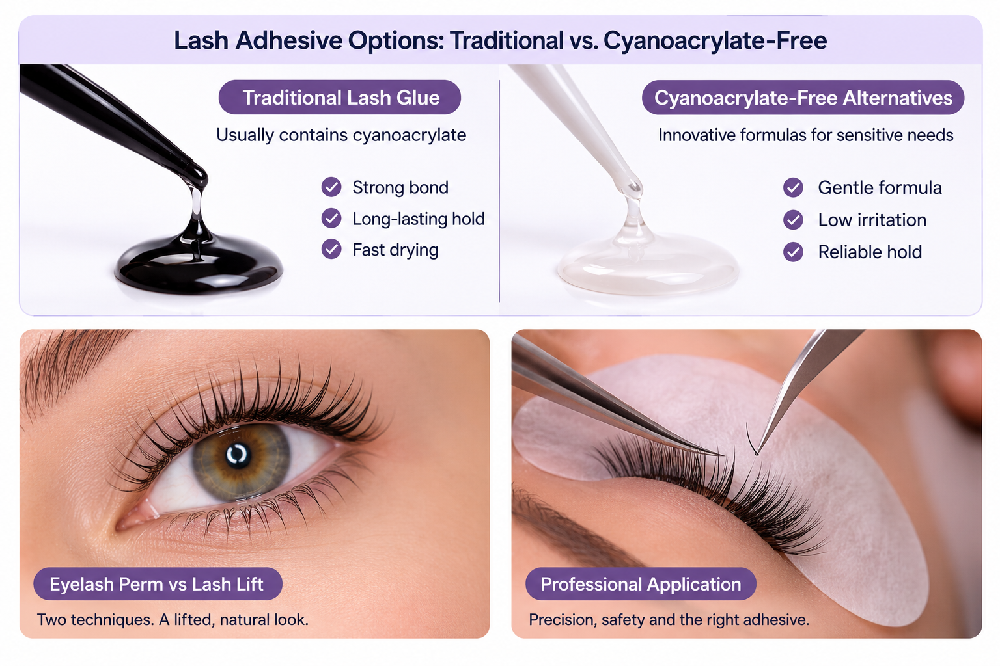
Before choosing an alternative, make sure the product is designed for the service you perform. The phrase eyelash glue covers several different applications:
| Adhesive type | Where it bonds | What to confirm |
|---|---|---|
| Professional extension adhesive | An individual extension or fan to an isolated natural lash | It is specifically designed and labelled for individual lash extensions |
| Strip-lash adhesive | The strip band to the eyelid area | It is intended for temporary strip lashes, not long-wear extension bonding |
| Cluster-lash adhesive | A cluster or segment according to the product's application method | The placement area, wear time and removal method stated by the manufacturer |
| Lash-lift adhesive | Natural lashes to a silicone shield or lifting support during a lift service | It is a positioning product for a lift, not a substitute for extension adhesive |
For example, the My Lamination Lash Lift Adhesive is intended for the lash-lifting process. Its presence in a catalogue of lash products does not make it an alternative professional extension glue.
What Replaces Cyanoacrylate in Professional Lash Adhesives?
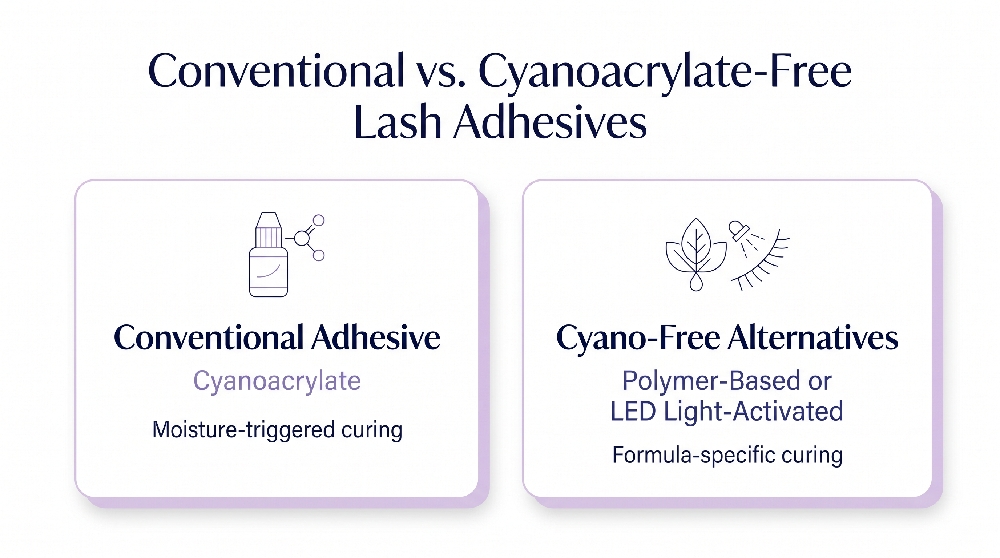
There is no single ingredient that replaces cyanoacrylate in every cyano-free product. The bonding system depends on the formulation. The label tells you that cyanoacrylate is not intended to be present; the ingredient list and product-specific technical documents tell you more about what the manufacturer uses instead.
Polyacrylate-Based Adhesive Formulations
Some cyano-free adhesive systems use polymer-based materials, including polyacrylate-type ingredients, as part of the bonding formulation. A polymer is not the same chemical family as cyanoacrylate, but that distinction should not be simplified into “acrylate-free” or “allergy-free”. The full composition matters: a product may be free of cyanoacrylate and still contain other acrylate or methacrylate ingredients.
Do not assume that every cyano-free adhesive is polyacrylate-based. Ask the manufacturer for the ingredient declaration and the current safety data sheet (SDS) for the exact product and formulation. If the manufacturer will not confirm the composition, treat the claim as unverified rather than filling the gap with assumptions.
LED and Light-Cured Alternative Adhesive Systems
Some alternatives are designed to cure when exposed to a compatible light source rather than relying on the same air- or moisture-triggered process as conventional cyanoacrylate adhesives. In one published example, Lash Plus lists trimethylolpropane triacrylate and Di-HEMA trimethylhexyl dicarbamate among the ingredients of its LED Cyano Free Glue, alongside a photoinitiator used for light curing. This is a product-specific example, not a universal formula for LED lash adhesives.
A light-cured adhesive is a system: the product, lamp or tweezer, wavelength, exposure distance, curing time and application method must be compatible. Use only the equipment and protocol authorised by the manufacturer. Do not assume that any LED lamp or UV device will cure any light-activated adhesive correctly.
How Does Cyano-Free Lash Glue Compare with Traditional Extension Adhesives?
The practical difference is not simply whether the glue contains cyanoacrylate. Lash artists also need to consider how quickly the bond sets, when the manufacturer considers it fully cured, the working environment, viscosity, retention expectations and whether extra equipment is required.
How Can Lash Artists Verify a Genuine Cyanoacrylate-Free Adhesive?
The most reliable approach is to confirm the exact product formula using current documents from the manufacturer. A reseller description or a short phrase on the bottle is not enough when the ingredient difference is central to the purchase decision.
Check the Complete Ingredient List and Product-Specific SDS
- Match the product identity: confirm the exact brand, product name, formula or version, and supplier.
- Read the ingredient declaration: check whether cyanoacrylate or a named cyanoacrylate appears in the published composition. Do not infer the formula from colour, viscosity or the word “sensitive”.
- Request the current SDS: confirm that the document matches the exact adhesive and revision. The composition section may not disclose every non-hazardous ingredient, so an SDS should be considered alongside the full ingredient declaration and written confirmation from the manufacturer.
- Keep the evidence: retain the label, batch details, ingredient information and supplier response for product traceability.
For a broader explanation of common lash adhesive ingredients, see WinLash's eyelash extension glue ingredients guide. Use it as background education, then check the technical documents for the exact adhesive you plan to use.
Verify Manufacturer Instructions and Curing Requirements
Read the full professional instructions before use. Confirm the application method, working temperature and humidity, cure or drying time, storage requirements, expiry after opening and any equipment specifications. For a light-activated adhesive, check the device model or approved light characteristics and follow the manufacturer's placement and exposure instructions. Never assume that a lamp is compatible because it is marketed for lash work.
Distinguish Supplier Claims from Verified Product Information
Product pages can help you shortlist options, but performance phrases such as “up to eight weeks”, “low irritation” or “for sensitive clients” remain manufacturer claims unless supported by suitable independent evidence. A meaningful comparison should state who made the claim, which product it refers to and under what specified conditions.
If the supplier cannot provide a full ingredient declaration or confirm in writing that the exact formula is free from cyanoacrylate, do not advertise or recommend it as a verified cyanoacrylate-free adhesive.
Is Sensitive, Low-Fume, Clear or Formaldehyde-Free Glue Also Cyano-Free?
No. These terms describe different properties and should not be treated as synonyms. A product can be clear or marketed for sensitive eyes while still listing cyanoacrylate in its ingredients.
| Label or claim | What it may describe | What it does not prove |
|---|---|---|
| Sensitive | A product marketed for users concerned about sensitivity | That the formula contains no cyanoacrylate or cannot cause a reaction |
| Low-fume | A claim about reduced fumes or vapour during use | That cyanoacrylate is absent |
| Clear / colourless | The appearance or lack of a dark pigment in the adhesive | That the bonding ingredient is cyano-free |
| Formaldehyde-free | A claim about the absence of formaldehyde as specified by the supplier | That the formula is free from cyanoacrylate |
| Cyanoacrylate-free | A claim that cyanoacrylate is not part of that product's formula | That the adhesive is hypoallergenic or suitable for every sensitive client |
A useful example is a clear adhesive that is marketed for sensitive eyes but lists Ethyl Cyanoacrylate in its published ingredients. That example shows why “clear” and “low-fume” are not chemical proof. Always read the ingredient declaration rather than relying on the product's colour or marketing category.
Frequently Asked Questions About Lash Glue Without Cyanoacrylate
Is there a lash glue without cyanoacrylate?
Yes. Some professional brands sell cyanoacrylate-free adhesives designed for eyelash extensions. Their formulas and curing methods vary, so verify the exact product's ingredients and instructions before use.
Is there any non-cyanoacrylate glue available for professional extensions?
Yes. Options include alternative polymer-based formulas and certain light-cured systems. They are not interchangeable, and some require a faster working method or compatible curing equipment.
Does cyanoacrylate-free lash glue prevent allergic reactions?
No. A cyano-free formula can still contain other ingredients capable of causing irritation or allergy. Anyone with a known adhesive allergy should get advice from a qualified healthcare professional before trying an alternative.
What's the safest lash glue?
There is no single adhesive that can be called the safest for every client. Choose a product intended for the exact lash service, check its ingredients and instructions, use compatible equipment, and avoid it when a client has a relevant known allergy or active eye-area irritation.
Is there a non-toxic eyelash glue?
“Non-toxic” should not be treated as a guarantee of zero risk. Any adhesive used near the eye must be specifically intended for that use and handled according to its label, ingredient information and professional instructions.
Can sensitive lash glue still contain cyanoacrylate?
Yes. “Sensitive” is not a chemical ingredient declaration. Check the exact formula; a clear, low-fume or sensitive-labelled glue may still contain a cyanoacrylate such as Ethyl Cyanoacrylate.
Where can I buy cyanoacrylate-free lash glue?
Look for professional suppliers that publish the exact ingredient declaration, current SDS and application instructions. Before ordering, confirm that the product is designed for individual lash extensions—not strip lashes, clusters or lash lifting—and that it can be used with your equipment and salon conditions.
Conclusion: Choose the Adhesive by Formula, Not by the Label
Professional lash extensions can be performed with certain cyanoacrylate-free adhesives. The important decision is not simply finding a bottle labelled “cyano-free”; it is understanding the alternative bonding system, its curing requirements and the ingredients that remain in the formula.
For lash artists, a careful product check means confirming the exact ingredient declaration, reviewing the current SDS, following the correct application instructions and avoiding unsupported promises about sensitivity or retention. A formula without cyanoacrylate may be an option for some clients, but it is not automatically suitable for everyone.
When reviewing your professional adhesive setup, explore the wider WinLash collection and check each product's specifications before choosing a glue for a particular service.
Shop WinLashProfessional education only. Product performance figures in this article are manufacturer-published specifications, not independent comparative test results. Always follow the current instructions and safety information for the exact adhesive and curing system used. This article does not replace professional training, a medical diagnosis or product-specific guidance.