
Ask any lash artist which request they hear most often, and the answer is almost always the same: "I want them to look natural." Natural lash extensions sound simple, but they're one of the hardest looks to get right. There's nowhere to hide. A length jump that's too big, a curl that doesn't match the client's own lashes, or a diameter that's slightly too heavy will read as "extensions" from across the room. Getting a truly natural result comes down to precise choices about length, curl, thickness and placement, all built on the client's own natural lashes. Choosing the right eyelash extensions is where that starts.
This guide walks through what makes natural looking lash extensions work: which application style to choose, how to select length, curl and diameter, how to map a natural set for different eye shapes, and how to protect the health of your client's natural lashes so every fill starts from a strong foundation.
Quick Access to This Article
- What Are Natural Lash Extensions?
- Classic vs. Hybrid vs. Light Volume: Which Looks Most Natural?
- Choosing Length, Curl and Diameter for Natural Looking Lash Extensions
- Natural Lash Mapping for Every Eye Shape
- Black vs. Brown Lashes for a Softer Finish
- Do Eyelash Extensions Damage Your Natural Lashes?
- Step-by-Step: Applying a Natural Classic Set
- Aftercare Advice to Give Your Clients
- Common Mistakes That Make Extensions Look Fake
- Frequently Asked Questions
- Conclusion
What Are Natural Lash Extensions?
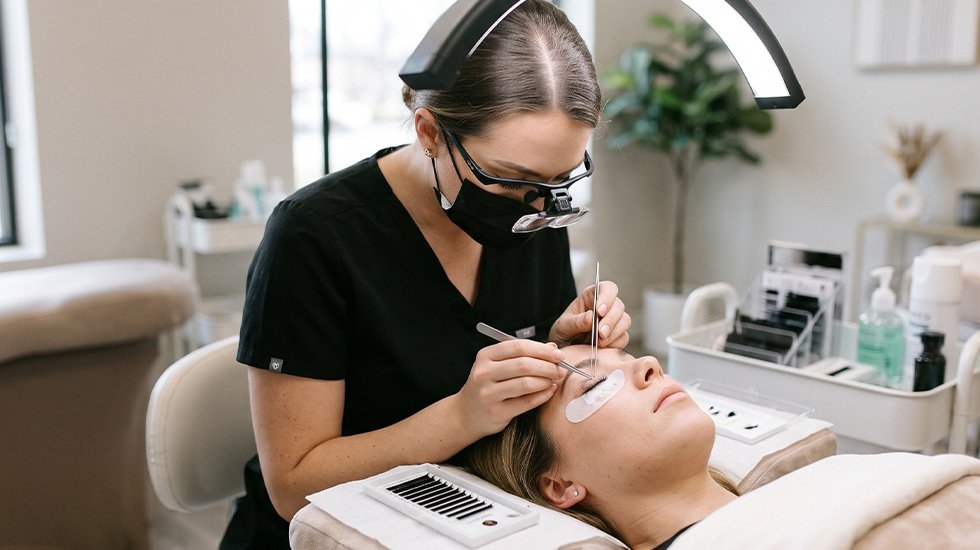
Natural lash extensions, sometimes searched for as natural eye lash extensions, aren't a separate product or a special fiber. They're a style of application. The goal is to make the client's own lashes look longer, darker and more defined, as if they were born with great lashes or had just applied a good mascara, rather than to add obvious volume or drama.
What defines a natural set is restraint and harmony with the natural lash line:
- Length stays close to the client's own lashes, with only a modest extension beyond each natural lash
- The curl mirrors the client's natural curl instead of forcing a dramatic lift
- Diameter is fine and lightweight, so the lash line looks defined rather than heavy
- Length transitions are gradual, with no sudden jumps from one zone to the next
- Density follows the client's natural lash count, without filling gaps so heavily that the lash line looks artificial
Because natural sets are lighter and closer to the client's own lashes, they're also one of the gentlest options for lash health. That's a big part of why they're the most common choice for first-time clients and for anyone who wants extensions they can wear every day, at work or at the gym.
Classic vs. Hybrid vs. Light Volume: Which Looks Most Natural?
When a client asks for natural lashes, most lash artists default to a classic set, and for good reason. But it isn't the only route. Depending on how many natural lashes the client has and how "full" they want the result, a hybrid or a very light volume set can also look natural when done carefully.
| Style | How it's applied | Natural-look result | Best for |
|---|---|---|---|
| Classic | One extension on one natural lash | Most natural, mascara-like definition | Clients with a healthy, reasonably dense natural lash line |
| Hybrid | A mix of classic lashes and small, soft fans | Natural with a little added fullness and texture | Clients with gaps or slightly sparse areas |
| Light volume (2D–3D) | Two or three ultra-fine extensions per natural lash | Soft, fluffy fullness, still natural when kept short and fine | Clients with sparse or fine natural lashes who want more density |
Classic: the default natural set
A classic set gives the most "my lashes, but better" result. Each natural lash receives a single extension, so the final look tracks the client's own lash pattern closely. For clients with a healthy, reasonably full lash line, classics in a fine diameter and modest length are usually all it takes.
Hybrid: natural with a little extra
Hybrids mix classic lashes with small, soft fans placed where the natural lash line is thinner. Kept short and soft, a hybrid fills gaps and adds texture without tipping into a dramatic look. It's a useful option for clients whose lash density is uneven.
Light volume: softness without weight
Light volume uses very fine fibers, typically in the 0.05–0.07 mm range, made into small 2D or 3D fans. Because each fiber is so fine, a light volume set can actually weigh about the same as a classic set while looking softer and fuller. For clients with sparse or fine lashes, a well-made black velvet volume lash palette lets you build soft, natural-looking density without overloading the natural lashes.
Choosing Length, Curl and Diameter for Natural Looking Lash Extensions
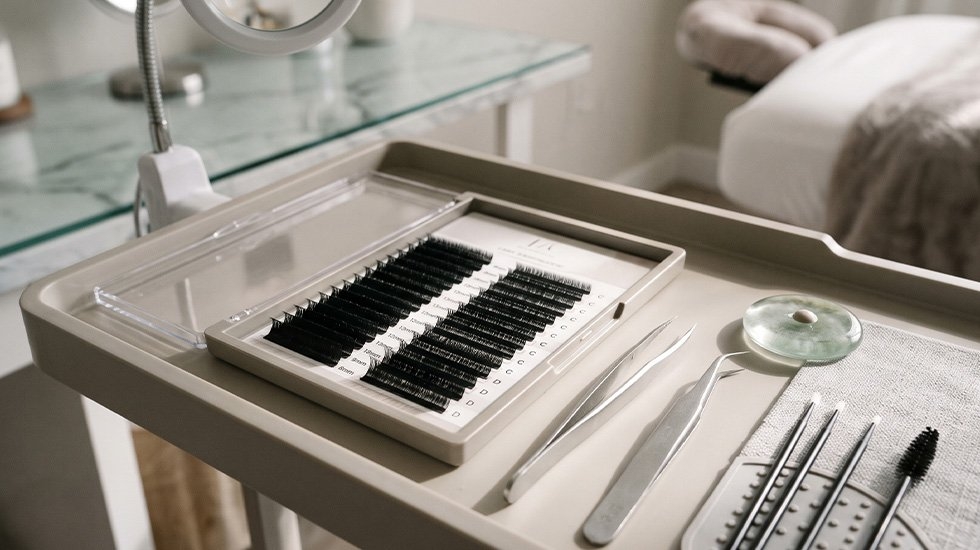
Every natural set comes down to three decisions: how long, how curled and how thick. Get these right for the individual client, and the set will look natural almost automatically. Get any one of them wrong, and no amount of careful isolation will save the result.
Length: stay close to the natural lash
The most important rule for natural looking lash extensions is keeping the extension close to the length of the natural lash it's attached to. A widely used guideline is to keep extensions no more than about 2–3 mm longer than the natural lash, and to go shorter still on fine or weak lashes. Beyond that range, the set starts to read as dramatic, and the extra length acts as a lever that puts more strain on the natural lash.
Length should also vary across the lash line the way natural lashes do: shorter in the inner corner, longest through the middle or slightly outward, and tapering gently at the outer corner. Many natural sets sit somewhere in the 8–12 mm range overall, but the right numbers always come from measuring the client's own lashes, not from a fixed chart.
Curl: match, don't force
Curl has a huge effect on whether a set looks natural. A curl that's much stronger than the client's own lashes makes the extensions stand out, and on straight natural lashes, a dramatic curl can also leave a gap between the natural lash and the extension base, which hurts retention.
| Curl | Lift | Natural-set use |
|---|---|---|
| J | Very subtle | Very straight natural lashes, ultra-natural results |
| B | Soft | Everyday natural sets and inner corners |
| C | Moderate | The most common natural-set curl, with gentle lift that still looks real |
| CC / D | Strong | Use sparingly in a natural set, usually only for naturally curly or downward-growing lashes |
Diameter and weight: lighter is more natural
Diameter (thickness) controls both how dark the lash line looks and how much weight each natural lash carries. For classic natural sets, many artists work in the 0.10–0.15 mm range, choosing the finer end for fine or weak lashes. Thicker diameters create a bolder, darker line and add weight, which makes them less suited to a natural look.
Use the table below as a starting point for matching extensions to the strength of the client's natural lashes:
| Natural lash condition | Suggested style | Diameter | Length guidance |
|---|---|---|---|
| Fine or weak | Classic or light volume | 0.05–0.07 mm (volume) or 0.10 mm (classic) | Close to natural length; avoid long extensions |
| Medium, healthy | Classic or hybrid | 0.10–0.12 mm | Up to about 2–3 mm longer than natural |
| Strong and thick | Classic | 0.12–0.15 mm | Up to about 2–3 mm longer, still graduated |
A reliable black lash extension palette with a full spread of lengths in one curl and diameter makes these graduated transitions much easier, because you can step up or down a single millimeter at a time without switching trays.
Natural Lash Mapping for Every Eye Shape
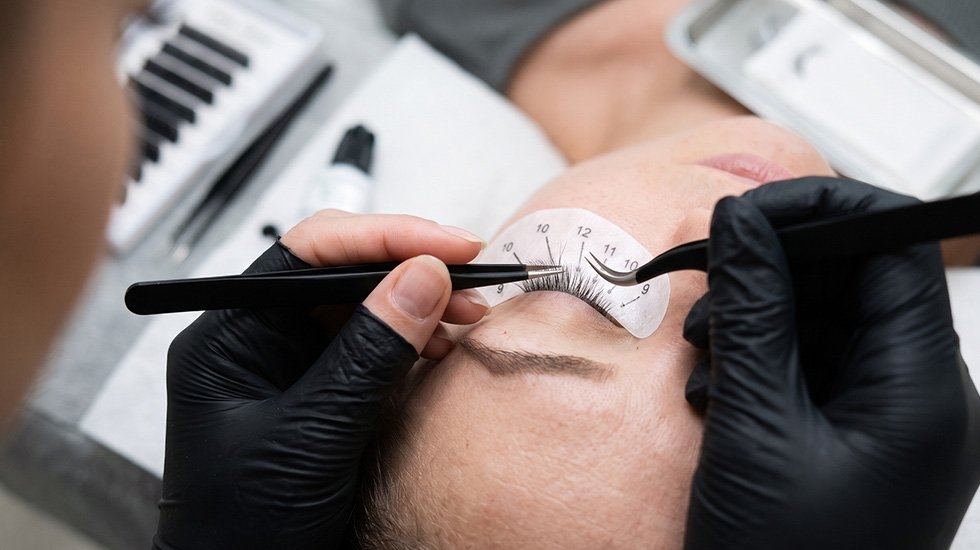
A lash map is a plan, usually marked on the under-eye pad, that shows which length and curl goes in each zone of the lash line. For natural sets, the map is simple in principle. It follows the client's natural lash pattern and makes small adjustments to flatter the eye shape.
A basic natural map starts short in the inner corner, increases gradually toward the middle or just past it, holds the longest length across a few lashes, and then steps down slightly at the outer corner. From there, adjust for eye shape:
| Eye shape | Natural map adjustment | Curl tip |
|---|---|---|
| Almond | Most natural maps work well; follow the natural lash pattern | B or C |
| Round | Place the longest lengths slightly toward the outer third to gently elongate | C |
| Hooded | Keep lengths moderate so lashes don't hit the lid fold; peak in the center | C for lift that clears the hood |
| Deep-set | Avoid very long lengths that touch the brow bone | B or C rather than strong curls |
| Monolid | Use a gentle center peak to open the eye without looking heavy | C, sometimes CC if lashes grow downward |
| Downturned | Lift the outer third slightly with a touch more length there | C |
Map each eye on its own rather than copying one side to the other. Natural lashes are rarely perfectly symmetrical, and small adjustments between eyes are what make the final set look balanced.
Black vs. Brown Lashes for a Softer Finish
Black is the standard color for lash extensions, and it works well for most clients, especially those with dark natural lashes. But for clients with light, blonde, red or fine natural lashes, or anyone who wants the softest possible result, black can create more contrast than they expect.
Brown lash extensions soften that contrast. They define the lash line in a gentler way, which suits fair-haired clients, very fine lashes and clients who usually skip mascara. Brown also works well mixed into a black set, especially in the inner corners, to soften the transition and make the overall result look more like real lashes. If you want to offer this option, a brown silk PBT lash palette is an easy way to build softer natural sets without changing your technique.
Do Eyelash Extensions Damage Your Natural Lashes?
This is one of the most common worries clients bring to their first appointment, and it's worth having a clear answer ready. When extensions are chosen and applied correctly, they don't damage natural lashes. Damage happens when specific mistakes are made, and natural sets are among the lowest-risk options because they're light and close to the natural lash length.
It also helps to explain the natural lash growth cycle. Natural lashes shed and regrow continuously, and it's normal to lose a few each day, with or without extensions. When an extension falls out attached to a natural lash, that's usually a lash that had reached the end of its cycle, not a sign of damage. Where real damage does occur, it almost always comes from one of the following causes.
Extensions that are too heavy or too long
An extension that's too thick or too long for the natural lash puts extra strain on the follicle. Over time, this can weaken lashes or cause them to shed early. Matching weight and length to the strength of each natural lash, as covered in the tables above, is the single most important protection.
Stickies: two natural lashes glued together
When an extension bonds two natural lashes together, they can't grow and shed independently. As one lash grows faster than the other, the bond pulls on the follicle and can cause discomfort or premature loss. Careful isolation and a final check with a lash comb prevents this.
Ignoring the growth cycle
Very short, fine baby lashes that are still in an early growth stage can't support an extension. Placing extensions on them, or putting long extensions on lashes that are nearly ready to shed, adds stress where the lash can't handle it.
Picking, pulling and improper removal
Clients who pick at their extensions, or remove them at home by pulling, can pull out natural lashes with them. Extensions should be removed professionally with a suitable adhesive remover so the bond dissolves rather than being forced off.
Step-by-Step: Applying a Natural Classic Set
- Consult and assess. Ask what "natural" means to the client, check their natural lash length, curl, density and strength, and note any sensitivities.
- Cleanse thoroughly. Remove makeup, oils and residue from the lashes so the adhesive can bond properly.
- Apply under-eye pads and map. Secure the pads comfortably, then mark your lengths by zone based on the client's natural lashes and eye shape.
- Isolate one natural lash at a time. Separate each lash cleanly to avoid stickies.
- Dip and place. Dip the base of the extension into a small amount of adhesive and place it slightly away from the skin, following the natural lash direction.
- Work in zones. Move across the lash line following your map, alternating eyes if needed to let adhesive cure evenly.
- Check and separate. Comb through the lashes and check from several angles that each natural lash moves freely.
- Finish and review. Remove the pads carefully, let the client see the result, and go over aftercare.
Aftercare Advice to Give Your Clients
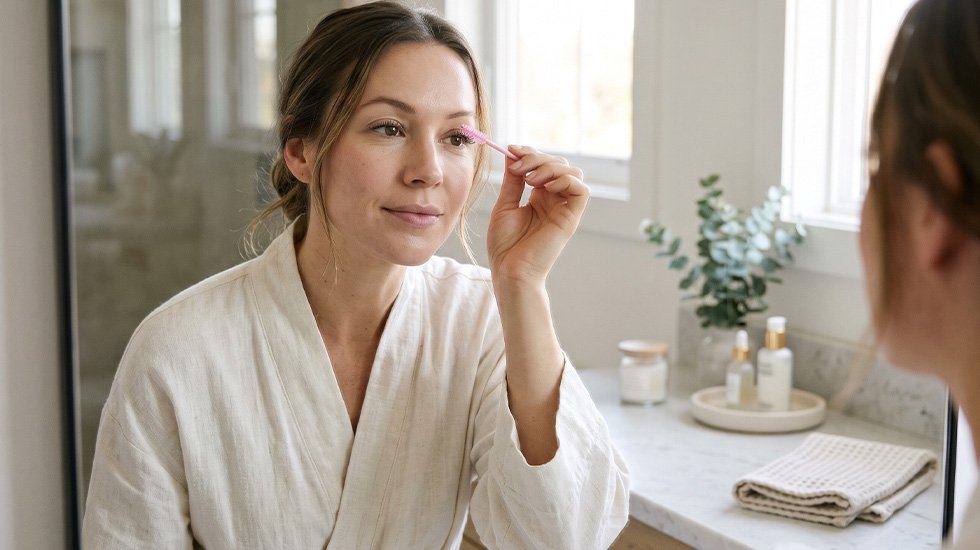
Good aftercare keeps a natural set looking fresh and protects the natural lashes underneath. Share these points at the end of every appointment:
- Avoid getting the lashes wet for the time recommended by your adhesive's instructions, often around the first 24 hours
- Clean the lashes regularly with a lash-safe cleanser to prevent oil and debris buildup along the lash line
- Brush the lashes gently with a clean spoolie each day
- Avoid oil-based products around the eyes, since oil can weaken the bond
- Don't rub, pull or pick at the extensions
- Avoid mechanical lash curlers and waterproof mascara
- Book fills regularly, typically every two to three weeks, so the set stays balanced as natural lashes shed and regrow
Common Mistakes That Make Extensions Look Fake
- Length jumps that are too big: moving several millimeters at once between zones creates a visible "step" instead of a smooth gradient
- Curl that's stronger than the natural lash: a dramatic curl on straight lashes looks artificial and can lower retention
- Diameters that are too thick: heavy lashes create a harsh, dark line and add stress to natural lashes
- Uniform length across the whole eye: natural lashes vary in length, so a flat, uniform set looks false
- Extensions placed too far from the natural lash direction: lashes that criss-cross or point in different directions break the natural effect
- Overfilling the inner corners: long or heavy lashes in the inner corner make the eye look heavy; keep them short and fine
- Mirroring one eye onto the other: copying a map without adjusting for natural asymmetry can make the eyes look uneven
Frequently Asked Questions
What are natural lash extensions?
Natural lash extensions are a style of application that enhances the client's own lashes with modest length, a matching curl and a fine diameter, so the result looks like naturally long, defined lashes rather than obvious extensions.
Which lash extension style looks the most natural?
A classic set, with one extension on each natural lash, usually looks the most natural. Hybrid or light volume sets can also look natural when they're kept short and soft, especially for clients with sparse lashes.
What length should natural looking lash extensions be?
Extensions for a natural look are usually kept close to the client's own lash length, often no more than about 2–3 mm longer than each natural lash, with shorter lengths in the inner corners.
Do eyelash extensions damage your natural lashes?
Not when they're applied correctly. Damage usually comes from extensions that are too heavy or long, stickies, ignoring the growth cycle, or picking and improper removal.
Are brown lash extensions more natural than black?
For clients with light or fine natural lashes, brown extensions often look softer and more natural than black. Many artists also blend a few brown lashes into a black set for a gentler finish.
How long do natural lash extensions last?
Extensions shed along with the natural lashes they're attached to, so most clients book a fill every two to three weeks to keep the set full and balanced.
Conclusion
Natural lash extensions are proof that subtle work is often the most technical. The difference between a set that looks real and one that looks fake comes down to small, deliberate choices: lengths that stay close to the natural lash, curls that match rather than force, fine diameters that protect lash health, and a map built around the client's own lash pattern and eye shape. Master those decisions, explain the growth cycle and aftercare clearly, and your natural sets will look beautiful on the first day and stay healthy through every fill.
Find professional lash extensions, palettes and studio supplies for every natural set at Winlash.