
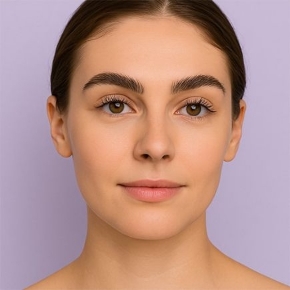
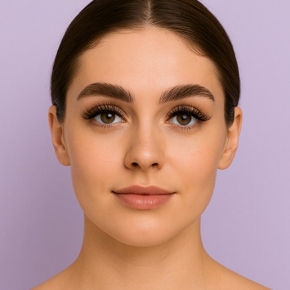
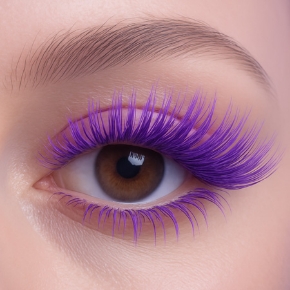
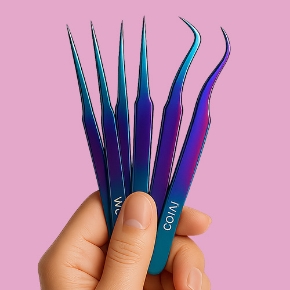

Lash extensions with glasses are one of the most common consultation challenges in any lash studio. Clients wearing prescription eyewear every day want the same open, defined eyes as everyone else—but if a set is too long or projects too far forward, the tips brush the lenses with every blink. That friction smudges glasses, causes eyelid irritation, and compromises retention. Fortunately, choosing the best eyelash extension length for glasses and balancing curl projection prevents lens contact completely, starting with selecting calibrated eyelash extensions in shorter, multi-curl trays.
Written by the WinLash Master Educator Team in Dubai, this technical guide is designed for both lash artists and glasses-wearing clients across the UAE. Below, we explain the mechanics of lens clearance, provide a frame-by-frame length and curl matrix, compare mapping styles, and share practical advice for wearing eyelashes with glasses or sunglasses in high-heat climates.
Key Takeaways
- Yes, clients can wear lash extensions with glasses; the set just needs to be designed around how close the lenses sit.
- Lens contact is caused by forward projection, which comes from length, curl and attachment angle together.
- Always measure clearance with the client's own glasses on before choosing lengths.
- Maps with the longest lengths in the centre are the riskiest; cat-eye and natural maps usually work better.
Quick Access to This Article
- Can You Wear Lash Extensions With Glasses?
- Why Lash Extensions Hit Glasses Lenses
- How to Measure Lens Clearance Before Lashing
- Best Lash Length by Frame Type
- Choosing the Curl: Lift vs Forward Projection
- Lash Mapping for Glasses Wearers
- Classic, Hybrid or Volume for Glasses Wearers?
- Sunglasses and Lash Extensions in the UAE
- For Clients: Aftercare When You Wear Glasses
- Common Mistakes With Glasses Wearers
- Frequently Asked Questions
- Conclusion
Can You Wear Lash Extensions With Glasses?

Yes. You can wear lash extensions with glasses as long as the set is designed so the extension tips stay clear of the lenses when the client blinks. That usually means choosing lengths based on the measured gap between the lash line and the lenses, using a curl that lifts the lashes upward rather than pushing them forward, and avoiding maps with very long lengths in the centre of the eye.
In many cases, eyelash extensions for glasses wearers are even more rewarding than for other clients. Frames draw a strong line across the face, and the lenses can make the eyes look smaller, especially with prescriptions for short-sightedness. A well-designed set defines the lash line and makes the eyes stand out behind the frame, without the mascara flakes and smudges that glasses wearers often complain about.
The key is that "one standard set" doesn't work for eyelash extensions with glasses. Two clients with identical natural lashes may need different lengths simply because their glasses sit at different distances from their eyes.
Why Lash Extensions Hit Glasses Lenses
Most problems with glasses and eyelash extensions come down to one thing: lash extensions touch glasses when the tips project far enough forward to reach the lens, either at rest or during blinking. Several factors decide how far forward the tips travel:
- Length: the most obvious factor; every extra millimetre moves the tips closer to the lens
- Curl: a stronger curl lifts the tips upward, but combined with a long length it can still project forward
- Attachment angle: extensions placed so they point forward, rather than following the natural lash direction, gain projection
- Natural lash direction: straight or downward-growing lashes project forward more than naturally upturned ones
- Frame fit: small frames, frames that sit high on the nose and frames for strong prescriptions often sit closer to the eyes
- Eye shape: deep-set eyes give more room; prominent eyes and a low brow bone give less
The prescription also changes how the lashes look. Lenses for short-sightedness tend to make the eyes, and the lashes, look smaller, while lenses for long-sightedness magnify them. A client with strong magnifying lenses may look fully "done" with a lighter set than you'd normally choose.
Lens contact isn't just annoying. Constant brushing and the habit of rubbing or adjusting the lashes put mechanical stress on the extensions and the natural lashes. The American Academy of Ophthalmology lists damage from rubbing or pulling among the risks of eyelash extensions, which is one more reason to design the set so the lenses never touch it.
How to Measure Lens Clearance Before Lashing
The single most useful habit with glasses wearers is measuring before you design. Ask the client to bring the glasses they wear most often, and if they alternate between prescription glasses and sunglasses, ask for both.
- Check the client's natural lashes with the glasses on. Ask them to look straight ahead and then blink slowly. Note whether their natural lashes already come close to the lenses.
- Look from the side. With the glasses on, view the eye in profile and estimate the gap between the lash line and the back of the lens in the inner, centre and outer areas. The centre of the eye is usually where the lens sits closest.
- Try a test extension. Hold or lightly place a single extension of the length and curl you're considering at the centre of the lash line, then have the client put their glasses back on and blink.
- Leave a safety margin. Choose a maximum length that stays clearly short of the lens, not one that just reaches it. Extensions flex as they grow out and the glasses shift during the day.
- Record it. Note the maximum length and curl for each area in the client's record so every fill starts from the same safe plan.
This takes a few minutes but is the most reliable way to plan lash extensions with glasses, and it prevents the most common complaint from glasses wearers: a set that looks perfect on the bed and taps the lenses as soon as they sit up.
Best Lash Length by Frame Type
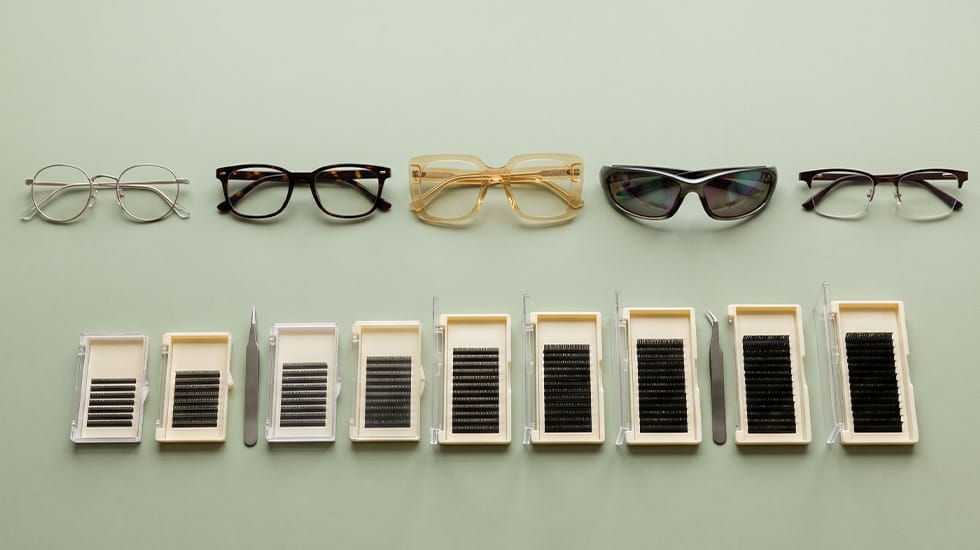
There's no universal "best length" for lash extensions with glasses, because the lens distance changes from frame to frame. Use the table below as a starting point, then confirm with the clearance test.
| Frame type | Typical lens distance | Suggested maximum length | Notes |
|---|---|---|---|
| Small or close-fitting frames | Close to the eye | About 8–10 mm | Rely on curl for lift, not length |
| Standard prescription frames | Average | About 9–11 mm | The most common range; test before going longer |
| Large or oversized frames | Often farther from the eye | About 10–12 mm | More room, but check the centre carefully |
| Wraparound or sports sunglasses | Very close, especially at the sides | Keep outer lengths moderate | Curved lenses can catch outer-corner lashes |
| Reading glasses | Varies; often worn lower on the nose | Usually more flexible | Ask how and when the client wears them |
A practical rule many artists use is to add only around 1–2 mm to the client's natural lash length for glasses wearers, rather than the bigger jumps you might use for a dramatic set. Having many lengths in one tray makes this fine-tuning much easier; an IB silk palette with 20 rows gives you enough rows to keep the shorter lengths you'll use most with these clients.
Matching lash density to frame thickness: Bold, thick acetate frames can visually swallow delicate classic lashes—pair heavy frames with a fuller, shorter volume set (9–10 mm) so the eyes remain defined. Conversely, thin wire-rimmed or rimless frames look best with lighter classic or 2D–3D sets that enhance the eye without overpowering the face.
Choosing the Curl: Lift vs Forward Projection
Advice about curls for glasses wearers often sounds contradictory. Some sources recommend strong D curls because they lift lashes away from the lenses; others warn that strong curls push tips toward the lenses. Both are partly right, because what actually matters is where the tip ends up.
A curl changes the direction of the extension, not just its look. A stronger curl turns the tip upward sooner, which can increase clearance when the length is moderate. But when a strong curl is combined with a long length, the extension can still travel forward before it turns up, and the tip ends up closer to the lens. In practice:
| Curl Type | Projection vs. Lift Profile | Suitable for Glasses Wearers? |
|---|---|---|
| J or B Curl | Straighter base with minimal upward lift; projects forward | No — High risk of tips brushing the lens |
| C Curl | Balanced, gentle upward curve with low forward projection | Yes — Safe all-round choice for close-fitting frames |
| CC Curl | Noticeable upward lift without excessive forward reach | Yes — Ideal balance of openness and lens clearance |
| D or DD Curl | Deep, dramatic upward curve that bends tips back toward the lid | Yes (with moderate length) — Best for straight or downward lashes |
| L or L+ Curl | Short flat base followed by a sharp upward angle | Yes — Cleans hooded lids and sits well behind standard frames |
The safest approach is to treat curl and length as one decision: if you go up in curl, consider coming down in length. Most lash trays at Winlash, such as the laser matte PBT eyelash palette, are available in several curl types, so you can keep two or three curls on hand for glasses wearers and test which one clears the lens best.
Lash Mapping for Glasses Wearers
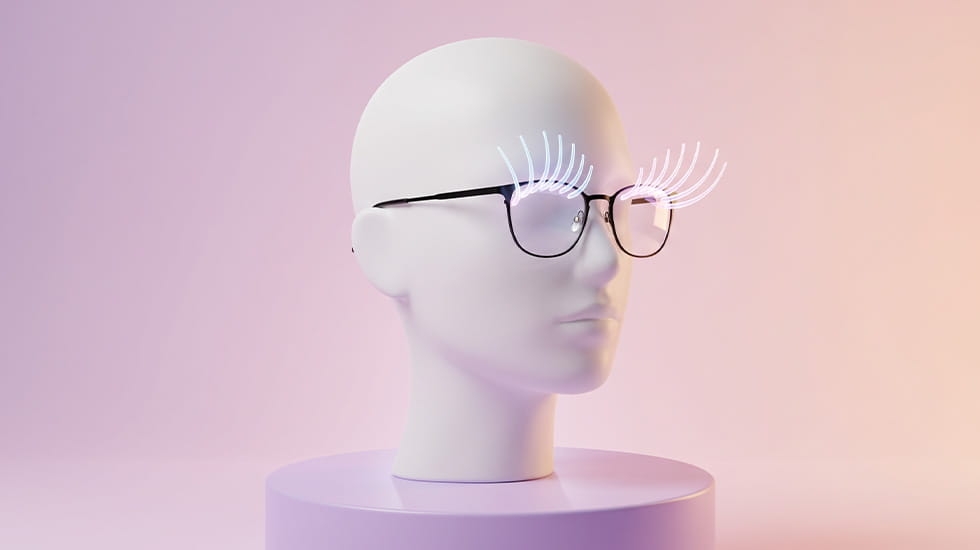
The lash map decides where the longest lengths sit, and that matters as much as the maximum length itself. The centre of the eye is usually where the lens is closest, so maps that put the longest lengths there carry the most risk.
| Lash map | Where the longest lengths sit | Suitable for glasses wearers? |
|---|---|---|
| Natural | Close to the natural lash pattern | Yes; a safe, flexible choice |
| Cat-eye | Toward the outer corner | Usually yes; keeps the centre shorter |
| Squirrel | Just before the outer corner | Usually yes, if the outer lengths clear the frame |
| Doll eye / Russian doll | In the centre of the eye | Risky; only with very short lengths and confirmed clearance |
If a glasses wearer asks for a doll-eye look, explain why the centre lengths need to stay short and offer a softer version with more curl and modest length. The Russian doll map is explained in more detail in our Russian eyelash extensions guide. For many glasses wearers, a soft map that follows their own lash pattern looks best of all; our natural lash extensions guide shows how to build that kind of set.
Classic, Hybrid or Volume for Glasses Wearers?
All three techniques can work with glasses. The difference lies mostly in weight, density and how the set reads behind the lenses:
- Classic: one extension per natural lash gives clean definition and is easy to keep short and light. Classic eyelash extensions suit clients who want subtle, mascara-like lashes behind their frames.
- Hybrid: a mix of classic lashes and small fans adds texture without much extra density, a good middle ground for everyday glasses wearers.
- Volume: lightweight fans create darkness and fullness without extra length, which is exactly what helps lashes stand out through lenses. Small, fine fans from our volume lashes collection let you build fullness while keeping the lengths short.
In practice, density is often a better tool than length when you're balancing lashes and glasses. When a client wants more impact, adding fullness at a safe length usually looks better, and causes fewer problems, than adding millimetres.
When to recommend a lash lift instead: If a client wears ultra-close-fitting frames or strong magnifying lenses where even an 8 mm extension touches the glass, a professional keratin lash lift and tint is the safest alternative. It curls natural lashes upward from the root for visible lift with zero added length.
Sunglasses and Lash Extensions in the UAE
In the UAE, many clients wear sunglasses for most of the day, and some switch between prescription glasses and sunglasses several times. That changes the consultation in a few ways:
- Ask about every pair. Large fashion sunglasses often sit farther from the eyes, while wraparound and sports styles sit very close, especially at the outer corners.
- Design for the closest pair. If one pair touches the lashes and another doesn't, the set has to clear the pair that sits closest.
- Watch the outer corners. Curved sunglasses can catch outer-corner lashes in cat-eye maps, so keep those lengths moderate for wraparound wearers.
- Heat and sweat matter. Sunglasses trap warmth around the eyes, and clients may wipe sweat from under the frames. Remind them to dab gently rather than rub.
For Clients: Aftercare When You Wear Glasses

Wearing eyelashes with glasses every day is easy once you build a few simple habits. These keep both your lash extensions with glasses and your lenses in good condition:
- Bring your glasses to every appointment, including fills, especially if you've changed frames.
- Take your glasses off with both hands, lifting them straight away from your face so the frame doesn't drag across your lashes.
- Clean your lenses away from your lashes. Remove your glasses before cleaning them, and avoid spraying lens cleaner close to your eyes.
- Cleanse your lashes regularly with a lash-safe foam. Clean lashes hold fewer oils and residues that can transfer to your lenses; a gentle formula such as the 4-in-1 cleansing foam is designed for the lash area.
- Brush your lashes daily so they stay separated and point in the right direction.
- Tell your artist if your lashes touch your lenses. It's easy to adjust the lengths or curl at your next fill.
- See an eye doctor if you notice persistent redness, swelling, itching or pain, and don't try to remove extensions yourself.
- If you switch between glasses and contact lenses: Always remove contact lenses before your lash appointment so eyes don't dry out under the pads, wear your glasses home afterward, and wait until any minor eye sensitivity settles before reinserting contacts.
Common Mistakes With Glasses Wearers
- Designing without the glasses: a set planned with the client lying down, without testing their frames, is a guess
- Using the same map as every other client: glasses wearers need a plan based on lens distance
- Adding curl and length at the same time: a stronger curl with a longer length often increases projection
- Long centre lengths: the centre of the eye is usually where the lens sits closest
- Forward-pointing attachment: extensions should follow the natural lash direction
- Heavy sets: thick, heavy extensions can droop as they grow out and move toward the lenses
- Forgetting sunglasses: a set that clears reading glasses may still touch wraparound sunglasses
- Not recording the plan: without notes, every fill starts from scratch
Frequently Asked Questions
Can you wear lash extensions with glasses?
Yes. A lash artist can design the set so the extensions stay clear of your lenses by choosing the right length, curl and lash map for your frames.
What is the best length for lash extensions with glasses?
It depends on how close your lenses sit. Many glasses wearers do well with lengths around 9–11 mm, but the safest length is the one confirmed by testing with your own glasses on.
What is the best curl for lash extensions with glasses?
C and CC curls are safe all-round choices. D curls can work for straight lashes if the length stays moderate, and L curls help hooded eyes and monolids.
Do lash extensions with glasses fall out faster?
They can if the extensions rub against the lenses or the client rubs the lashes when adjusting the glasses. A set that clears the lenses shouldn't lose retention because of glasses.
Will glasses hide my eyelash extensions?
Not if the set is designed well. Extensions define the lash line so your eyes stand out behind the frames, especially with a little extra density rather than extra length.
What should I do if my lash extensions touch my glasses?
Tell your lash artist. At your next fill they can shorten the lengths in the area that touches, change the curl or adjust the map. In the meantime, avoid trimming or pulling the extensions yourself.
Conclusion
Lash extensions with glasses work beautifully when the set is designed around the frames instead of a standard map. Measure lens clearance with the client's own glasses on, control forward projection by treating length and curl as one decision, keep the longest lengths away from the centre where lenses sit closest, and use density rather than extra length for impact. Add a quick conversation about sunglasses and a clear aftercare routine, and your glasses-wearing clients will enjoy lashes that look great and never tap their lenses.
Find lash trays in every length and curl, plus aftercare and studio supplies for your next set, at Winlash.